
When your immune system turns against your own body, it doesn’t just cause pain-it steals your ability to do the things you need and want to do. Getting dressed. Holding a coffee cup. Walking to the kitchen. For people with autoimmune diseases like rheumatoid arthritis, lupus, Sjögren’s, or fibromyalgia, these simple acts become daily battles. Functional impairment isn’t just about joint swelling or muscle weakness. It’s about losing control over your own life. The good news? Rehabilitation and occupational therapy aren’t just helpful-they’re often the difference between isolation and independence.
Why Functional Impairment Happens in Autoimmune Disease
Autoimmune diseases don’t just attack joints or skin. They trigger chronic inflammation that wears down your body over time. This inflammation causes tissue damage, pain, and fatigue that go beyond what most people think of as "arthritis." You might have swelling in your hands, but the real problem is that you can’t open a jar anymore. Or your knees hurt, but you’re avoiding stairs because each step leaves you drained for days. Add to that the side effects of medications-steroids that weaken muscles, immunosuppressants that make you feel like you’re always sick-and you’ve got a perfect storm. Many patients aren’t weak because they’re lazy. They’re weak because their bodies are fighting a war inside them, 24/7. Research shows that 5-8% of people globally live with an autoimmune condition, and women are three times more likely to be affected. By the time most people seek rehab, they’ve already lost 30-50% of their functional capacity. That’s not normal aging. That’s disease progression.How Physical Therapy Helps You Move Again
Physical therapy (PT) focuses on restoring movement. But it’s not about pushing through pain. It’s about working with your body’s limits, not against them. During a flare, when inflammation is high, PT uses gentle isometric exercises-muscle contractions without joint movement-at just 20-30% of your maximum effort. This keeps muscles active without making inflammation worse. Once you’re in remission, therapists slowly introduce aerobic training, keeping your heart rate at 40-60% of your reserve. That’s not a spin class. That’s a slow walk on a treadmill, monitored with a heart rate strap. Studies show that structured PT improves lower body function by up to 28% compared to occupational therapy alone, measured by how fast you can stand up from a chair and walk 3 meters (the Timed Up and Go test). Hydrotherapy-exercising in warm water (92-96°F)-cuts pain by 22% more than land-based workouts. The water supports your joints, reduces swelling, and lets you move without fear. But here’s the catch: 68% of rural clinics don’t even have a pool. That’s why home-based programs are growing fast. Many therapists now use video calls to guide patients through safe movements using resistance bands, chairs, or even walls for support.Occupational Therapy: Relearning How to Live
If PT helps you walk, OT helps you live. Occupational therapists don’t just teach you how to use a cane. They teach you how to cook, type, brush your teeth, and get dressed without burning out. They use the 4 Ps: Prioritize (what tasks matter most?), Plan (when’s the best time of day to do them?), Pace (break everything into 15-20 minute chunks), and Position (use ergonomic tools to reduce strain). For someone with hand deformities from rheumatoid arthritis, that might mean switching from a regular knife to a spring-loaded one. Or using voice-activated smart home systems to turn on lights, adjust the thermostat, or call for help-tools that boost independence by 31% in studies. OT also uses the Canadian Occupational Performance Measure (COPM), a tool that asks you what activities matter most to you. Is it playing with your grandkids? Writing emails? Cooking Sunday dinner? The therapist then builds a plan around those goals-not generic exercises.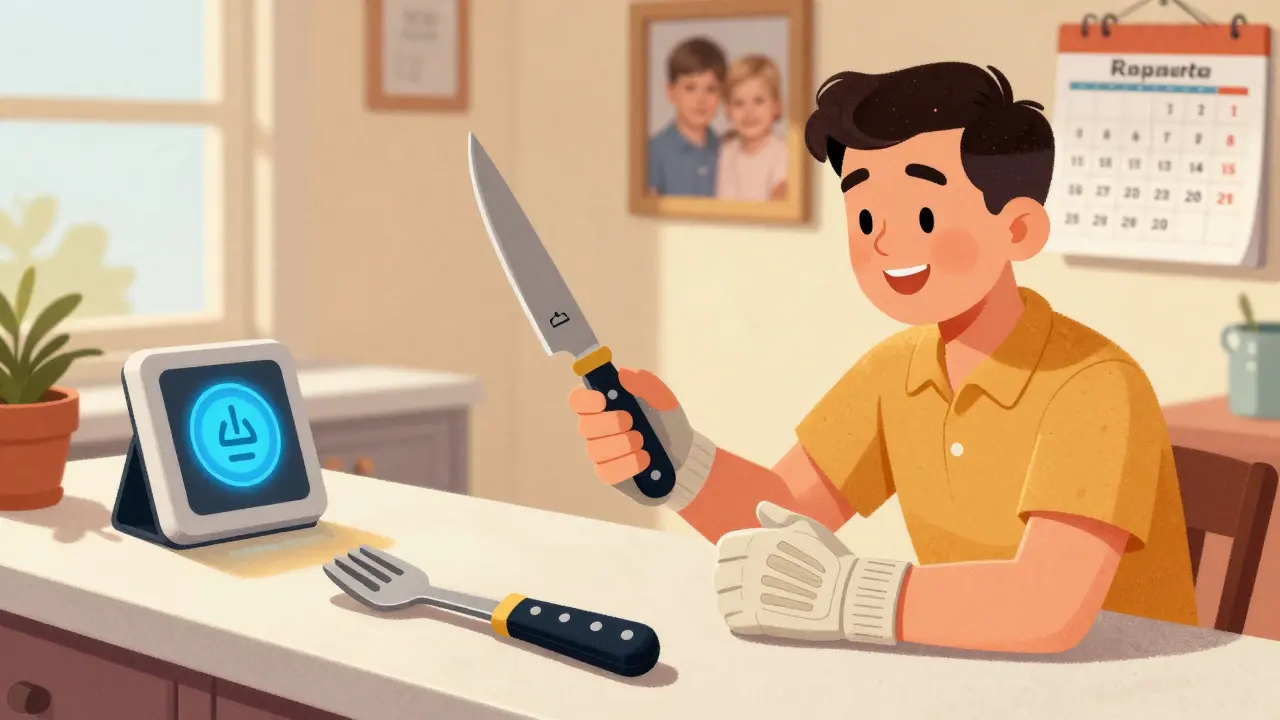
Measuring Success: It’s Not Just Pain
Doctors track inflammation with blood tests. Rehab teams track function with tools like the Health Assessment Questionnaire Disability Index (HAQ-DI). This isn’t a number on a chart. It’s your ability to do 20 daily tasks-from dressing to shopping to climbing stairs. A 1-point drop on the HAQ-DI scale is meaningful. A 1.8-point drop-common after 6 months of consistent rehab-means you go from needing help to get dressed to doing it alone. That’s life-changing. Studies show structured rehab improves HAQ-DI scores by 35-42% when started early. The best results happen within the first year of symptoms. Waiting too long means muscle loss and joint stiffness become permanent.The Biggest Mistake Patients Make
The most common error? Doing too much on good days. People with autoimmune diseases often have what’s called the "boom-bust cycle." You feel okay one day, so you clean the whole house, go shopping, and visit friends. The next day, you’re stuck in bed for three days. That’s not laziness. That’s your nervous system overreacting to overexertion. Experts call this central fatigue-a deep, unrelenting tiredness that doesn’t go away with sleep. And it’s not just in your head. Brain imaging shows it’s a real neurological response in conditions like lupus and Sjögren’s. The solution? The 70% rule. Never push yourself past 70% of your perceived maximum effort. If you feel like you’re at 80%, stop. Use an activity diary and a wearable heart rate monitor to learn your personal limits. One patient, u/RheumaWarrior on Reddit, dropped their HAQ-DI from 2.1 to 0.8 after six months of this approach-and went back to part-time work.What Doesn’t Work-and Why
Not all rehab is created equal. Some therapists still push patients to "just keep moving" through pain. That’s dangerous. Active joint swelling, fever over 100.4°F, or recent steroid injections are red flags. Exercise during these times can make things worse. Another problem? Insurance. Most plans cover only 12-15 sessions a year. But studies show you need 24-30 to see real results. That’s why many patients give up after a few months. Also, not all therapists know autoimmune diseases. A 2021 study found 19% of rehab programs ignore central fatigue entirely, leading to crashes. Look for therapists with specialized training-like the Academy of Pelvic Health Physical Therapy’s Autoimmune Specialty Certification. It’s a 120-hour program, and only 78% pass.
What’s New in 2025
The field is changing fast. The NIH launched the Autoimmune Rehabilitation Registry in 2023, tracking over 5,000 patients across 47 clinics. New research shows that adjusting exercise intensity based on weekly blood markers like IL-6 improves outcomes by 39%. Apps like Lupus Foundation’s "PacePartner" are now in final trials. It uses data from wearables to predict flares with 82% accuracy. Imagine getting a notification: "Your heart rate variability suggests a flare is coming. Try a gentle walk today, skip the grocery run." Medicare raised reimbursement rates by 5.7% in 2024 for chronic condition rehab-good news for access. But there’s a looming crisis: the U.S. will face an 18,000-therapist shortage by 2026. That means waiting lists are growing. If you need help, start now.How to Get Started
1. Ask your rheumatologist for a referral to a therapist trained in autoimmune conditions. Don’t settle for a general PT or OT. 2. Start with a functional assessment. Make sure they use HAQ-DI or COPM to set real goals. 3. Track your energy. Use a simple app or notebook to log daily activities and how you felt afterward. Look for patterns. 4. Use the 70% rule. Always leave a little in the tank. Overdoing it today means losing tomorrow. 5. Push for more sessions. If insurance denies coverage, ask for a letter of medical necessity from your doctor. Many patients get approved on appeal.Final Thought: It’s Not About Getting Back to Normal
You won’t go back to who you were before the diagnosis. And that’s okay. The goal isn’t to be "normal." It’s to be you-with your own new limits, your own new tools, your own new way of living. Rehabilitation doesn’t cure autoimmune disease. But it gives you back control. It lets you choose how much of your life you’re willing to lose. And for many, that’s worth more than any drug.Can physical therapy make autoimmune symptoms worse?
Yes-if it’s done wrong. Pushing through pain, using high-intensity workouts during flares, or ignoring signs of central fatigue can trigger crashes. But when tailored to your disease phase and intensity level, physical therapy reduces pain and improves function. Always work with a therapist trained in autoimmune conditions.
How long does it take to see results from occupational therapy?
Most patients notice small improvements in daily tasks-like opening jars or buttoning shirts-within 4-6 weeks. Meaningful gains in independence, measured by the COPM, usually appear after 3-6 months of consistent therapy. The key is consistency, not intensity.
Is hydrotherapy better than land-based exercise for autoimmune disease?
During active flares, yes. Hydrotherapy reduces pain by 22% more than land-based exercise and is easier on swollen joints. The warm water also helps with stiffness and circulation. But if you don’t have access to a pool, land-based exercises with proper pacing can still be very effective.
Why do I feel more tired after therapy sessions?
You might be overdoing it. Autoimmune fatigue isn’t like regular tiredness. It’s neurological and can be triggered by even small increases in activity. If you’re crashing for days after therapy, your program may be too aggressive. Talk to your therapist about lowering intensity and using the 70% rule.
Does insurance cover rehab for autoimmune diseases?
It depends. Many plans limit coverage to 12-15 sessions per year, even though 24-30 are often needed. Some states don’t have specific billing codes for autoimmune rehab, leading to claim denials. Ask your therapist for a letter of medical necessity and appeal denials-many patients succeed on second try.
Can I do rehab at home?
Absolutely. Many effective programs are now delivered via telehealth. Your therapist can guide you through exercises using resistance bands, household items, and video feedback. Home programs are especially helpful if you live far from a clinic or have mobility issues. Just make sure your therapist is trained in autoimmune conditions.
What’s the 70% rule and why does it matter?
The 70% rule means never pushing yourself past 70% of your perceived maximum effort. It’s not about pain-it’s about energy. If you feel like you’re at 80%, stop. This prevents the boom-bust cycle and reduces flare risk. Patients who follow this rule report fewer crashes and better long-term function.
How do I find a therapist who understands autoimmune disease?
Look for therapists with certifications like the Academy of Pelvic Health Physical Therapy’s Autoimmune Specialty Certification. Ask if they’ve worked with patients with your specific condition (lupus, RA, etc.) and if they use tools like HAQ-DI or COPM. Avoid therapists who say "just keep moving" or ignore fatigue.






Write a comment
Your email address will be restricted to us