Codeine Interaction Checker
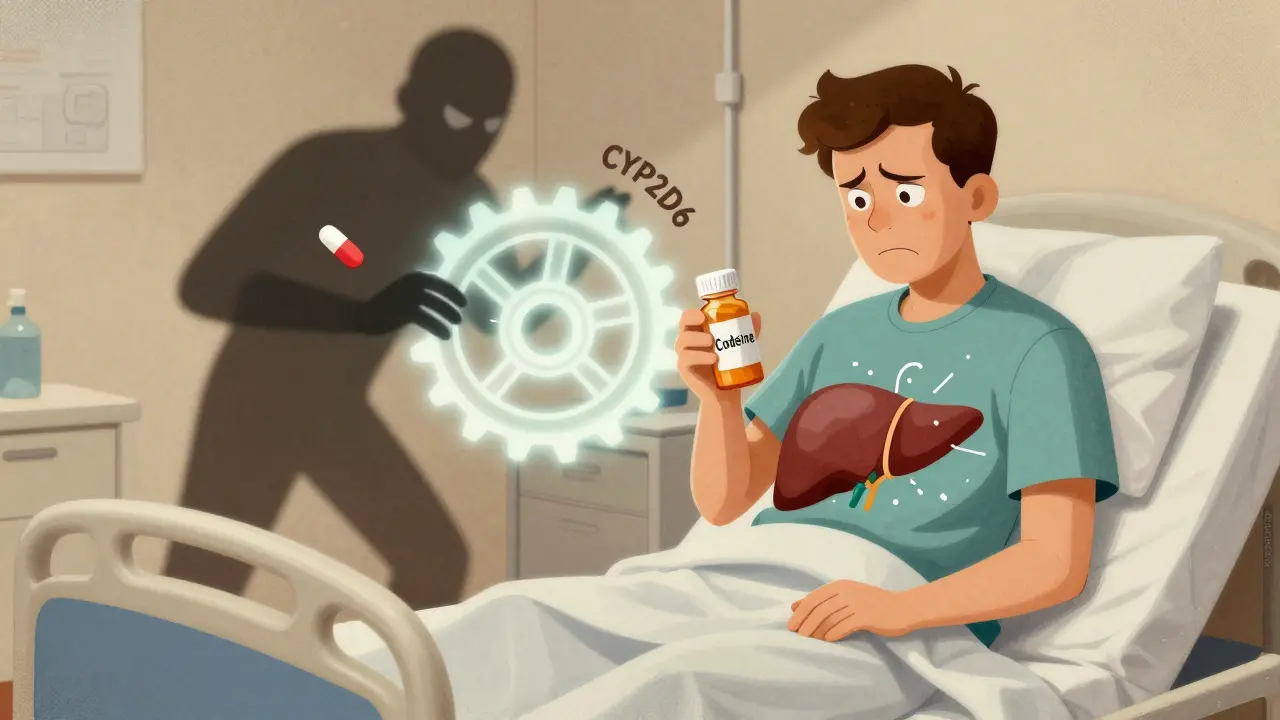
This tool helps you determine if your current medications could interfere with codeine's ability to relieve pain. Codeine needs to be converted to morphine by the CYP2D6 enzyme in your liver. Certain medications block this enzyme, making codeine ineffective.
You take codeine for pain - maybe after surgery, a dental procedure, or a bad back flare-up. You follow the dose exactly. But the pain doesn’t go away. You think it’s just bad pain. Or maybe you’re just not sensitive to it. But what if the real problem isn’t your body - it’s your antidepressant?
Codeine Doesn’t Work Like You Think
Codeine isn’t the painkiller itself. It’s a placeholder. Your body has to turn it into morphine to feel any relief. That transformation happens in your liver, thanks to an enzyme called CYP2D6. About 5 to 10% of every codeine pill becomes morphine this way. If your CYP2D6 enzyme is blocked, almost none of that conversion happens. And without morphine, codeine is basically sugar.
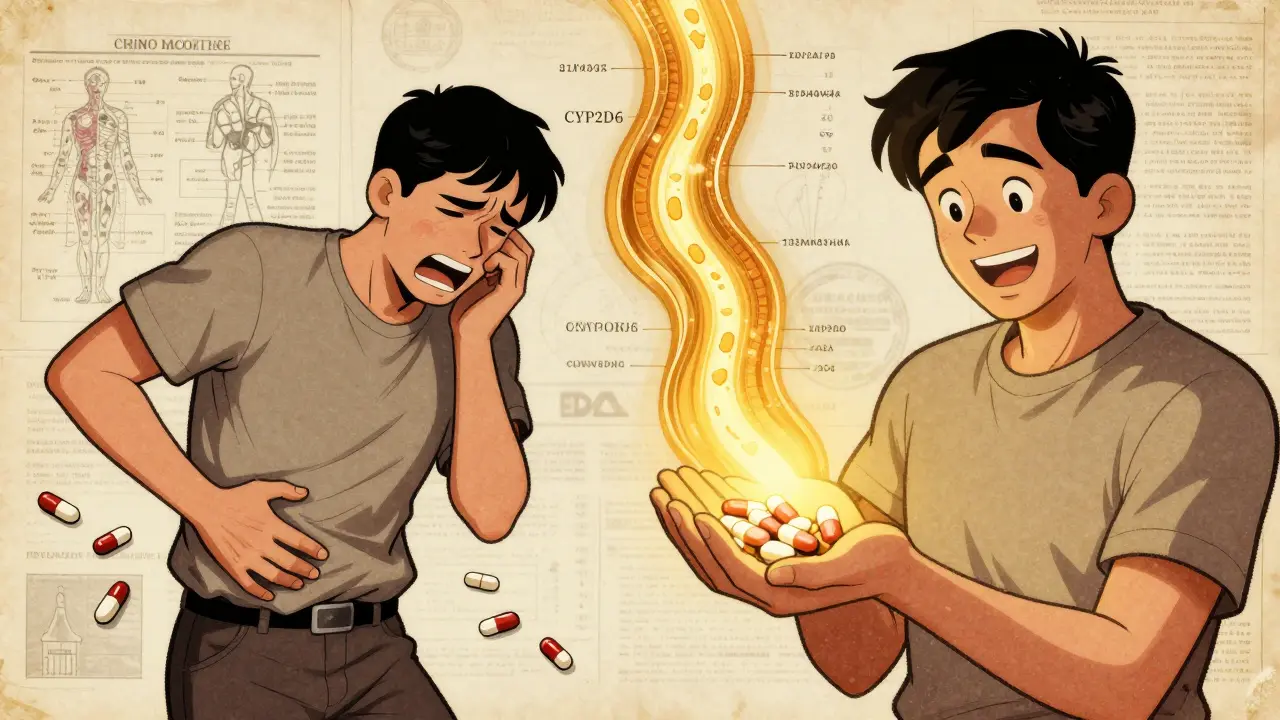
This isn’t theory. In 2004, researchers gave healthy volunteers paroxetine - a common antidepressant - and then gave them codeine. The result? Morphine levels dropped by 85%. Pain relief vanished. The same thing happened in real patients: those on paroxetine reported 62% less pain control than those not taking it. This isn’t rare. A 2020 survey of over 1,200 pain specialists found that nearly 8 out of 10 had seen patients with codeine that just… didn’t work - and the culprit was almost always an SSRI like fluoxetine or paroxetine.
Why Fluoxetine and Paroxetine Are the Worst Offenders
Not all antidepressants mess with codeine. Only the ones that shut down CYP2D6. Fluoxetine and paroxetine are the two strongest offenders. Paroxetine is especially potent - it binds so tightly to CYP2D6 that it can turn even a normal metabolizer into a functional poor metabolizer. Think of it like jamming a lock so nothing can turn. Fluoxetine isn’t far behind. Both have Ki values under 0.2 µM, meaning they block the enzyme at very low concentrations - the kind you get from a regular daily dose.
Compare that to other SSRIs. Sertraline? It’s a moderate blocker. Citalopram and escitalopram? Almost no effect. If you’re on an SSRI and need pain relief, switching from fluoxetine or paroxetine to escitalopram could be the difference between agony and comfort.
The FDA Warned - But Many Still Don’t Listen
The U.S. Food and Drug Administration flagged this interaction in 2007. They tightened the warning again in 2012. The European Medicines Agency followed in 2015. The Clinical Pharmacogenetics Implementation Consortium (CPIC) says outright: avoid codeine if you’re taking strong CYP2D6 inhibitors like fluoxetine or paroxetine. Yet, prescriptions still happen.
Why? Because doctors don’t always think about drug interactions when they’re focused on pain. Patients don’t always mention their antidepressants. Pharmacists might not catch it unless they’re specifically looking. The FDA’s own database shows 247 reports between 2010 and 2020 of people getting codeine while on paroxetine - and reporting zero pain relief. That’s not a coincidence. That’s a pattern.

What Happens When Codeine Fails - And What to Do Instead
Imagine this: you’re in the hospital after surgery. You’re on paroxetine for depression. The nurse gives you codeine. You take it. Nothing. You ask for more. You’re told you’re probably just sensitive to pain. You’re given more. Still nothing. You’re labeled as "difficult." You’re frustrated. Your pain gets worse. Your stress spikes. Your depression gets harder to manage.
This isn’t hypothetical. A nurse from Massachusetts General Hospital shared a case on a medical forum: a 45-year-old woman on paroxetine got codeine after a hysterectomy. Zero pain relief. Switched to oxycodone - pain gone in 20 minutes.
So what’s the fix? Stop using codeine. Use an opioid that doesn’t need CYP2D6 to work. Oxycodone. Hydromorphone. Morphine. These drugs are active as-is. No conversion needed. No enzyme to block. They work whether you’re on fluoxetine, paroxetine, or nothing at all.
Hydrocodone is another option - it’s metabolized mostly by CYP3A4, not CYP2D6. It’s still a strong painkiller, and it won’t be sabotaged by your antidepressant.
How to Protect Yourself
If you’re on fluoxetine or paroxetine and you’re prescribed codeine, speak up. Ask: "Does this interact with my antidepressant?" If your doctor says "no," ask for the evidence. If they’re unsure, ask for an alternative.
Pharmacists can help too. A 2022 study showed that when pharmacists screened for CYP2D6 inhibitors before dispensing codeine, they prevented over 1,800 treatment failures in just six months across 15 hospitals. That’s not just good practice - it’s life-changing.
Some hospitals now use genetic testing to check your CYP2D6 status before prescribing opioids. If you’re a poor or intermediate metabolizer - or if you’re on a strong inhibitor - codeine is automatically flagged. This isn’t science fiction. It’s happening in U.S. hospitals right now.
Why This Matters Beyond Pain Relief
This isn’t just about pain. It’s about trust. When your medication doesn’t work, you start doubting your doctor. You start doubting yourself. You might think you’re exaggerating. You might stop taking your meds. You might self-medicate with something unsafe. Or worse - you might think you’re addicted because you need more pain relief, when really, your body just can’t process the drug.
And it’s not just you. This interaction affects thousands. Codeine prescriptions in the U.S. have dropped 43% since 2010 - not because people are using less painkillers, but because doctors are learning to avoid this trap. In Europe, 12 countries have restricted codeine sales because of these risks.
Meanwhile, the global pharmacogenomics market is growing fast - because people are realizing: your genes and your meds matter. Your body doesn’t respond the same way as the person next to you. That’s not weakness. That’s biology.
What You Should Do Today
- If you’re on fluoxetine or paroxetine and get prescribed codeine - ask for an alternative like oxycodone or morphine.
- If you’re already taking both and your pain isn’t controlled - talk to your doctor. Don’t assume it’s "in your head."
- If you’re switching antidepressants, avoid fluoxetine and paroxetine if you might need opioids in the future. Choose escitalopram or citalopram instead.
- If you’re a pharmacist or prescriber - check for CYP2D6 inhibitors before dispensing codeine. It’s simple. It’s effective. It saves people from unnecessary suffering.
This interaction is well-documented. It’s predictable. It’s avoidable. And yet, it still happens - because no one’s asking the right questions. Don’t let that be you.
Why doesn’t codeine work if I’m on fluoxetine or paroxetine?
Codeine needs to be converted into morphine by the CYP2D6 enzyme in your liver to relieve pain. Fluoxetine and paroxetine block this enzyme so effectively that almost no morphine is made. Without morphine, codeine has no painkilling effect - even if you take the full dose.
Is this interaction dangerous or just ineffective?
Primarily, it’s ineffective - but that can be dangerous. If you don’t get pain relief, you might take more codeine, risking side effects like dizziness, nausea, or constipation without any benefit. In some cases, people turn to stronger, unregulated painkillers. The real danger is delayed recovery, increased stress, and misdiagnosis of your condition.
Can I just take more codeine to make up for it?
No. Taking more codeine won’t help. The enzyme is blocked - extra codeine just sits in your system. You’ll increase side effects without increasing pain relief. It’s not a dose problem. It’s a metabolism problem. You need a different drug, not more of the same.
What are the best alternatives to codeine if I’m on an SSRI?
Oxycodone, morphine, and hydromorphone are the top choices. They don’t rely on CYP2D6 to work. Hydrocodone is also safe - it’s mainly broken down by CYP3A4. Avoid tramadol too - it also needs CYP2D6 to become active. Always ask your doctor for an opioid that’s not dependent on this enzyme.
Should I get tested for CYP2D6 genetics?
It’s not required, but it’s helpful - especially if you’re on long-term antidepressants and might need opioids in the future. If you’re a poor or intermediate metabolizer, codeine won’t work for you even without an SSRI. Testing can prevent future issues. Many U.S. hospitals now offer this testing, and it’s becoming more affordable.
Is this interaction only with SSRIs?
No. Other drugs like bupropion, quinidine, and even some antifungals and heart medications can block CYP2D6. But fluoxetine and paroxetine are the most common culprits because they’re widely prescribed for depression and anxiety. Always check your full medication list with your pharmacist.
Can I switch my antidepressant to avoid this?
Yes - and it’s often the best solution. If you’re on fluoxetine or paroxetine and need pain relief, switching to escitalopram or citalopram can eliminate this interaction entirely. These SSRIs don’t block CYP2D6. Talk to your doctor about whether a switch makes sense for your mental health and pain management goals.





Write a comment
Your email address will be restricted to us