Vitamin K Consistency Calculator for Warfarin Patients
Daily Vitamin K Tracker
Keep your vitamin K intake between 90-120 µg daily for stable INR levels on warfarin therapy.
Your Vitamin K Intake
When you're on warfarin, your diet isn't just about eating healthy-it's about eating consistent. Many people hear they need to avoid green vegetables altogether, but that’s outdated advice. The real key isn’t cutting out vitamin K. It’s keeping your intake steady every single day. That’s what keeps your INR numbers stable, avoids dangerous blood clots or bleeding, and lets you live without constant fear of lab results.
Why Vitamin K Matters So Much on Warfarin
Warfarin works by blocking vitamin K’s role in making clotting factors. Think of vitamin K as the gas pedal for blood clotting. Warfarin steps on the brake. If you suddenly eat a lot of vitamin K-like a big plate of cooked spinach-you’re pressing the gas again. Your INR drops. If you skip your usual greens for a week, the brake gets too strong. Your INR spikes. Either way, you’re at risk.The magic number for most people on warfarin is an INR between 2.0 and 3.0. Go below 2.0, and clots can form. Above 3.0, you risk bleeding. Studies show that patients who keep their daily vitamin K intake within 90-120 micrograms-and don’t swing wildly day to day-spend 75-80% of their time in that safe range. Those who eat inconsistent amounts? Only 55-65%. That’s a huge difference in safety.
Which Foods Have the Most Vitamin K?
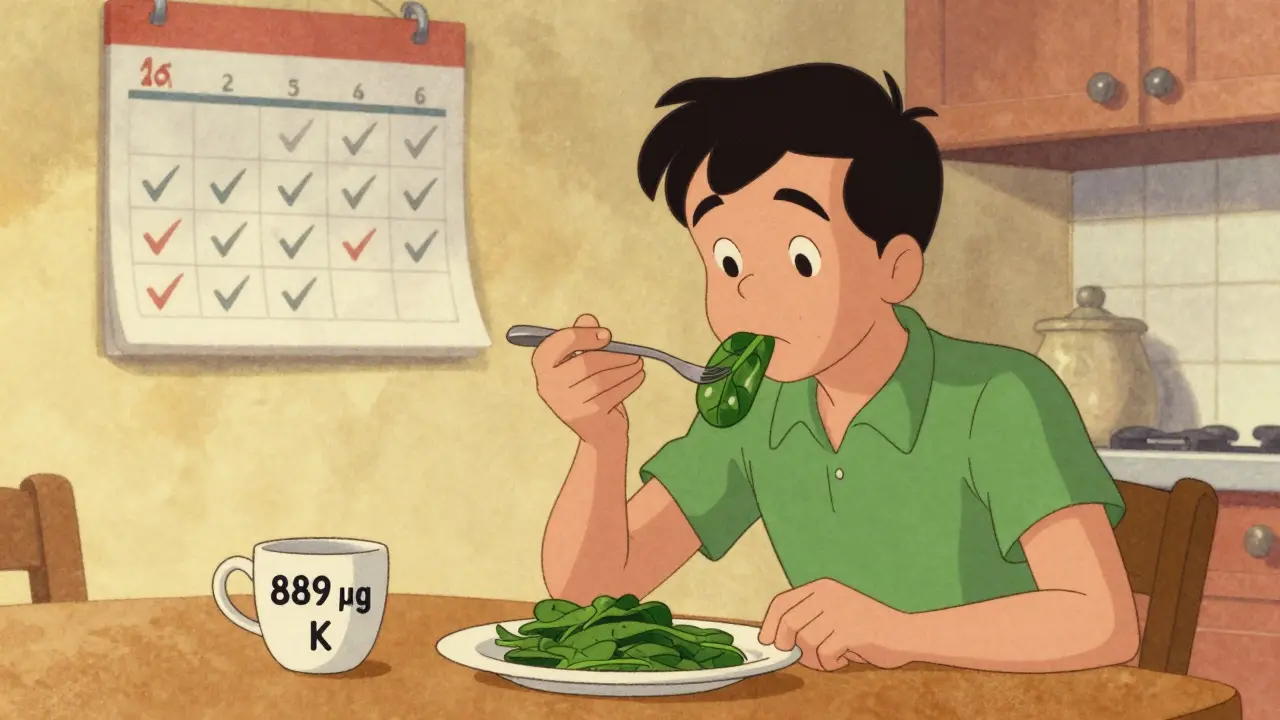
Not all greens are created equal. Some are packed with vitamin K1, the kind that directly affects warfarin. Here’s what you need to know about the big ones:- Cooked spinach: 889 µg per cup
- Cooked kale: 547 µg per cup
- Cooked collard greens: 772 µg per cup
- Cooked broccoli: 220 µg per cup
- Cooked Brussels sprouts: 220 µg per cup
- Raw spinach: 145 µg per cup
- Asparagus: 70 µg per half-cup
- Green beans: 14 µg per half-cup
Notice the big jump between raw and cooked spinach? Cooking concentrates vitamin K. A cup of raw spinach is fine. A cup of cooked? That’s almost nine times more. That’s why people get surprised-their INR crashes after switching from salad to sautéed greens.
Consistency Over Restriction: The Only Rule That Works
For years, doctors told patients to avoid vitamin K. That advice is wrong-and dangerous. Trying to eliminate it means even a small slip-up-a bite of broccoli at a restaurant, a smoothie with kale-can send your INR plunging. That’s when emergency visits happen.The American Heart Association, American College of Cardiology, and American Society of Hematology all agree: don’t restrict. Stabilize. Pick one or two high-vitamin K foods you like. Eat the same amount every day. If you like cooked spinach, have one cup daily. If you prefer broccoli, have one cup every day. Don’t alternate. Don’t skip. Don’t binge.
One patient in the American Heart Association’s support network ate exactly one cup of baby spinach every morning. Her INR stability jumped from 52% to 81% in six months. Another Reddit user ate three servings of kale salad in one day-normally she ate almost none. Her INR dropped from 2.5 to 1.8 overnight. She needed a dose adjustment. That’s the kind of swing you avoid with consistency.

What About Other Foods and Supplements?
It’s not just greens. Some supplements and processed foods sneak in vitamin K:- Ensure® nutritional shake: 50 µg per serving
- Boost® drink: 55 µg per serving
- Many multivitamins: 50-150 µg (check labels)
- Fermented foods like natto: extremely high (not recommended unless you eat it daily)
If you take a daily multivitamin, check the label. If it has vitamin K, make sure it’s the same amount every day. Don’t switch brands. Don’t stop and start. Same rule applies: consistency beats avoidance.
Antibiotics can also mess with your INR. They kill gut bacteria that make vitamin K2. If you’re on antibiotics, your vitamin K drops. That means your INR can rise-even if you eat the same food. Talk to your anticoagulation clinic before starting any new meds.
How to Build a Consistent Routine
You don’t need to be a nutritionist. You just need a simple plan.- Pick one high-vitamin K food you enjoy (spinach, broccoli, or kale).
- Decide on a portion size (e.g., 1 cup cooked).
- Eat it every day, same time, same amount.
- Keep other greens low and steady (e.g., lettuce, cucumber, carrots).
- Avoid sudden changes: no giant salads on weekends, no fasting before blood tests.
Meal prep helps. Cook a batch of broccoli on Sunday. Eat the same portion Monday through Friday. That way, you’re not guessing at dinner time. Apps like MyFitnessPal or CoumaDiet can track your daily intake. One study found patients using these apps improved their time in therapeutic range by over 12%.
What If Your INR Keeps Fluctuating?
Sometimes, even with consistency, INR stays unstable. That’s when doctors might consider vitamin K supplements. Yes, you read that right. Taking 100-150 µg of vitamin K daily as a supplement can actually stabilize your blood thinning. It sounds backwards, but research shows it works. Your body gets used to a steady level, so it doesn’t overreact to food.This isn’t for everyone. It’s only for patients who’ve tried everything else and still have wild INR swings. Talk to your anticoagulation clinic. Don’t self-prescribe.

Common Mistakes and How to Avoid Them
- Mistake: Eating kale salad on Sunday, then nothing the rest of the week. Solution: Eat one serving daily, no exceptions.
- Mistake: Avoiding all greens because you heard it’s dangerous. Solution: Eat the same amount every day-it’s safer than avoidance.
- Mistake: Skipping meals during illness. Solution: Even if you’re sick, try to eat your usual portion. If you can’t, call your clinic. Illness can raise INR fast.
- Mistake: Getting conflicting advice from different doctors. Solution: Ask for the latest guidelines. The 2023 American College of Chest Physicians and Anticoagulation Forum both say: consistency, not restriction.
One study found 63% of patients got mixed messages from their providers. That’s why so many people are confused. Don’t rely on guesswork. Get your advice from a certified anticoagulation clinic or a dietitian trained in warfarin management.
Why Warfarin Is Still Used in 2025
Newer blood thinners like apixaban and rivaroxaban don’t need diet changes. So why is warfarin still prescribed to 35% of new atrial fibrillation patients? Because it’s cheap. Generic warfarin costs $4-$10 a month. The alternatives? Around $3,500 a year. For many, especially older adults, that’s the difference between taking the medicine and not taking it at all.And warfarin has one big advantage: it can be reversed quickly if you bleed. Newer drugs don’t have that. If you have a fall or need surgery, doctors can give you vitamin K or fresh plasma to stop the bleeding fast. That’s life-saving.
So yes, warfarin is old. But it’s still essential. And with smart, consistent eating, it works.
What to Do Next
Start today. Don’t wait for your next blood test.- Write down what you eat for three days. Use MyFitnessPal or a notebook.
- Find your highest vitamin K food. Decide if you can eat it daily.
- Set a daily goal: 90-120 µg. Stick to it.
- Call your anticoagulation clinic. Ask if they have a food list with exact µg values.
- Download CoumaDiet or INR Tracker Pro if you’re tech-savvy.
It takes 8-12 weeks to build a habit. But once you do, your INR will settle. You’ll sleep better. You won’t panic before your lab visit. You’ll feel in control.
Can I eat spinach while on warfarin?
Yes, but only if you eat the same amount every day. One cup of cooked spinach has nearly 900 µg of vitamin K. That’s fine if you eat it daily. But if you eat it one day and skip it the next, your INR will swing dangerously. Consistency is everything.
Should I avoid all green vegetables on warfarin?
No. Avoiding greens increases your risk of unstable INR. The best approach is to eat a consistent amount of one or two high-vitamin K vegetables daily. Low-vitamin K veggies like lettuce, cucumbers, and carrots can be eaten freely without affecting your INR.
What happens if I eat a lot of vitamin K one day?
Your INR will likely drop within 3-5 days. A single high intake-like a large kale salad-can lower your INR by 0.5 to 1.0 points. That’s enough to increase your risk of clotting. If you accidentally eat a lot, call your clinic. Don’t change your warfarin dose yourself.
Can vitamin K supplements help stabilize my INR?
Yes, for some people. If your INR stays unstable despite consistent eating, your doctor may prescribe 100-150 µg of vitamin K daily as a supplement. This sounds counterintuitive, but it helps your body adjust to a steady level, reducing wild swings. Never take supplements without medical supervision.
Why do some doctors still tell me to avoid vitamin K?
Many doctors, especially outside anticoagulation clinics, still follow outdated advice from 10-15 years ago. Current guidelines from the American Heart Association, American College of Cardiology, and American Society of Hematology all say restriction is harmful. Ask for the latest guidelines or ask to be referred to a certified anticoagulation clinic.
Does cooking affect vitamin K levels?
Yes, dramatically. Cooking reduces water content and concentrates vitamin K. One cup of raw spinach has about 145 µg. One cup of cooked spinach has nearly 900 µg. That’s why switching from salad to sautéed greens can crash your INR. Always track your food by how it’s prepared, not just the name.




Write a comment
Your email address will be restricted to us