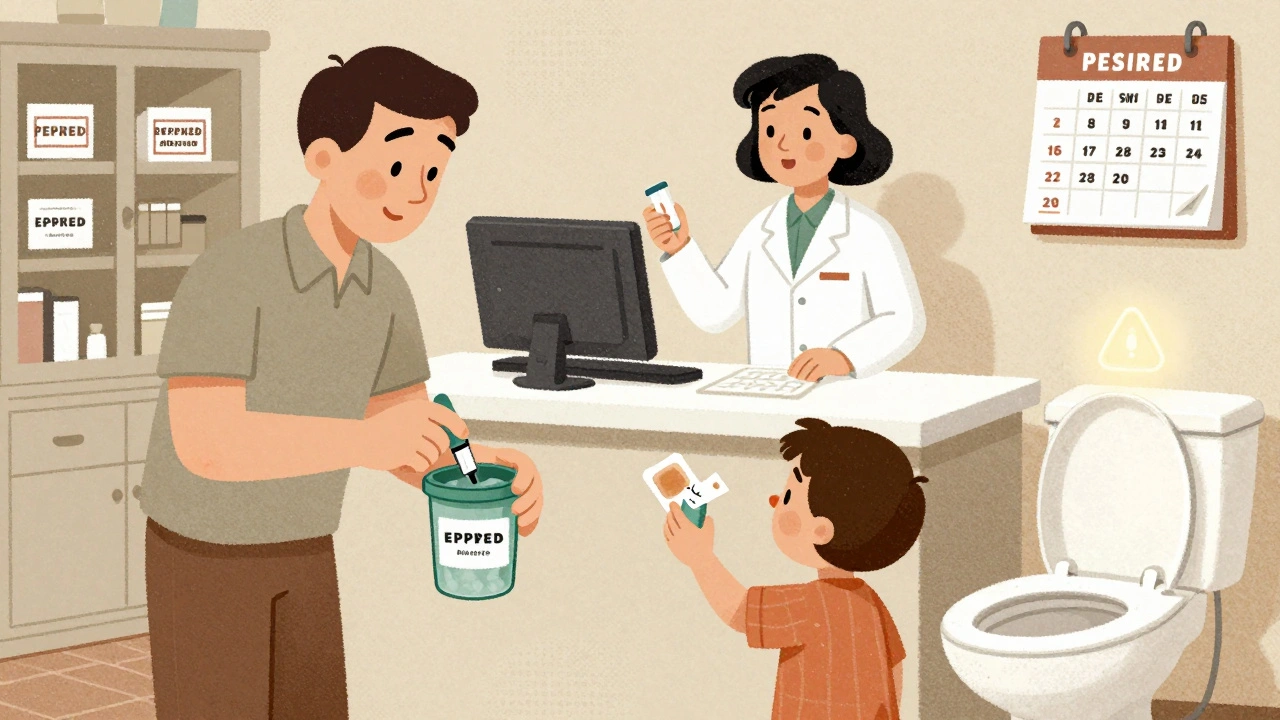
How to Safely Dispose of Expired EpiPens, Inhalers, and Patches

3

December
  • Categories: Health
  • Comments: 15

Why Proper Disposal Matters

Expired EpiPens, inhalers, and medicated patches aren’t just old medicine-they’re potential hazards. An unused EpiPen sitting in a drawer might save someone’s life, but if it ends up in the trash or flushed down the toilet the wrong way, it could hurt a child, a pet, or pollute your local water supply. The same goes for inhalers: those little canisters are pressurized, and if they’re crushed or thrown into a fire, they can explode. Patches like fentanyl or nicotine still hold powerful drugs on their sticky surface, even after they’ve been used. According to the FDA, 12% of accidental poisonings in kids come from improperly thrown-away medications. That’s not a small number. It’s a preventable risk.

How to Dispose of Expired EpiPens

EpiPens are not regular trash. They have a needle inside, which makes them medical sharps-just like syringes. You can’t just toss them in the recycling bin or throw them in the garbage without protection. The safest and easiest way is to take your expired EpiPen back to the place where you got it: your doctor’s office or pharmacy. Most allergists and clinics have sharps disposal bins and will take them without asking questions. If you’re getting a new prescription, just bring the old one with you.

If that’s not an option, look for a DEA-authorized drug take-back location. These are often at police stations, hospitals, or participating pharmacies. You can find the nearest one using the DEA’s National Take Back Initiative website. Don’t rely on your local CVS or Walgreens unless you call ahead-many only take pills, not auto-injectors.

For temporary storage at home, put the EpiPen in a hard plastic container like an empty laundry detergent bottle. Make sure the lid screws on tight. Label it clearly: “SHARPS,” “BIOHAZARD,” and “DO NOT RECYCLE.” Keep it out of reach of kids and pets. Never try to remove the needle or break it apart. That’s dangerous and illegal in many places. The AAAAI says these devices should be treated exactly like needles used in a doctor’s office-no exceptions.

What to Do with Old Inhalers

Inhalers are tricky. They’re not just plastic and metal-they contain propellants that are harmful to the environment. When these canisters end up in landfills or incinerators, they release greenhouse gases. Around 300 million inhalers are thrown away every year in the U.S. alone. So, don’t just toss them in the bin.

First, check the label. Some manufacturers give specific disposal instructions. If it says “do not puncture,” that’s your clue to avoid the trash. Many cities have special collection sites for aerosols. New York City, for example, accepts inhalers at Household Special Waste Drop-Off Sites. Check your local waste authority’s website or call them. Some pharmacies like Walgreens offer take-back programs, but only about half of their locations participate. Don’t assume yours does-call first.

If no drop-off exists nearby, the FDA says you can dispose of inhalers in household trash-but only after you remove the metal canister from the plastic holder. Punch a hole in the canister to release the pressure (wear gloves and do it outside if possible). Then throw the canister and plastic parts in separate bins. The plastic can go in recycling if your program accepts it. The metal canister goes in the trash. This isn’t ideal, but it’s better than leaving a pressurized can in a garbage truck.
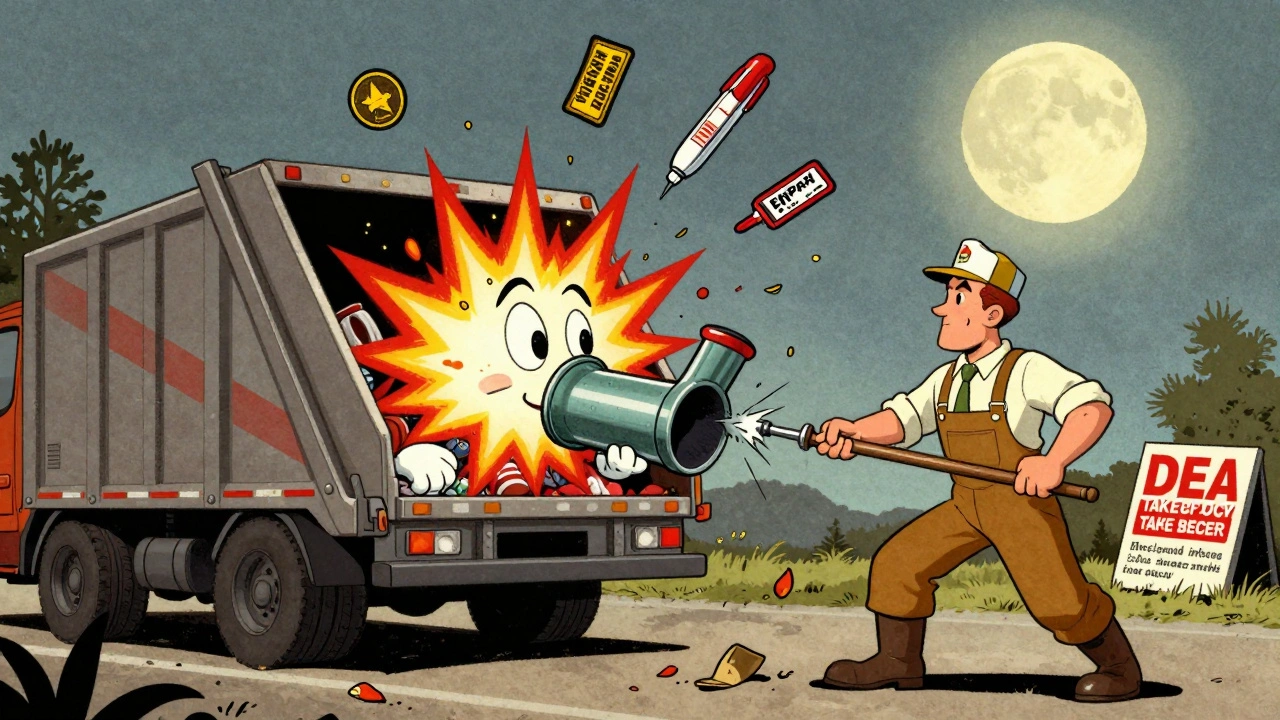
A giant inhaler about to explode in a garbage truck as a worker safely punctures it outdoors under the moonlight.

Disposing of Medicated Patches

Patches are different. They’re not sharp, but they’re still dangerous if handled wrong. Fentanyl patches, for example, can kill someone if they touch the sticky side-even after use. The FDA has a special “flush list” of medications that should be flushed immediately to prevent accidental exposure. Fentanyl patches are on that list. So if you have one, fold it in half with the sticky sides together, then flush it down the toilet. Yes, really. That’s the official recommendation from Nationwide Children’s Hospital and the DEA.

For other patches-like nicotine, lidocaine, or hormone patches-flushing isn’t always necessary. The safest method is to remove the patch, fold it so the adhesive sticks to itself, and put it in a sealed container with something unappetizing like coffee grounds or cat litter. Then throw it in the trash. This keeps kids and pets from finding it. Don’t use DisposeRx® packets for patches-they’re designed for pills and liquids, not transdermal patches.

Another option: wait for the DEA’s National Prescription Drug Take Back Day. It happens twice a year, usually in April and October. Thousands of locations across the country accept all kinds of medications, including patches. In October 2022, they collected nearly a half-million pounds of drugs. It’s one of the most effective ways to dispose of them safely.

What NOT to Do

Here’s a quick list of mistakes people make:

  • Don’t put EpiPens in recycling bins. The needle makes them hazardous waste.
  • Don’t flush non-listed patches. Only flush fentanyl and other FDA-approved drugs.
  • Don’t burn inhalers or puncture them without releasing pressure first.
  • Don’t leave expired devices in reach of children or pets-even if they seem “empty.”
  • Don’t assume your pharmacy takes everything. Always call ahead.
A woman sealing used patches in a jar with coffee grounds beside a sharps container and a mail-back envelope in a vintage-style home.

How to Stay Prepared

Prevention is better than cleanup. Check your EpiPens, inhalers, and patches every month. Mark the expiration date on your calendar. Set a reminder on your phone. Most devices last about a year after being opened. If you’ve had one for over a year, even if it hasn’t expired, it might not work properly.

Keep a small sharps container at home. You can buy one at any pharmacy for $5-$15. Use it for all your used or expired injectables. When it’s full, take it to a drop-off location. Some insurance plans even cover the cost. If you live in a rural area, mail-back programs exist. Companies like Safe Needle Disposal offer prepaid envelopes to send sharps to certified facilities.

Ask your pharmacist or doctor about disposal options during your next visit. Many still don’t mention it-but you’re entitled to know. The American Medical Association now recommends that providers educate patients on disposal during every prescription refill.

What’s Changing in 2025

Things are getting better. California passed a law in 2024 that requires drugmakers to pay for disposal programs. That means more drop-off bins at pharmacies, more mail-back options, and better labeling on packaging. Mylan, the maker of EpiPens, started adding QR codes to their boxes that link directly to disposal instructions. Other companies are following.

The EPA is also updating rules to limit pharmaceutical waste in waterways. Studies show 80% of rivers and streams in the U.S. now contain traces of medications. That’s not just an environmental issue-it’s a public health one. Better disposal means cleaner water, safer communities, and fewer accidental poisonings.

If you’ve ever struggled to find a place to drop off an expired EpiPen, you’re not alone. A 2023 survey found that 68% of people had trouble locating a disposal site. But awareness is growing. More hospitals, police stations, and pharmacies are stepping up. You just have to know where to look.

Can I throw expired EpiPens in the regular trash?

No. EpiPens have a needle and are classified as medical sharps. Throwing them in the trash risks injury to sanitation workers and children. Always use a sharps container and take it to a designated drop-off location like a pharmacy, hospital, or DEA take-back site.

Do pharmacies accept inhalers for disposal?

Some do, but not all. Only about 47% of Walgreens locations accept inhalers, and CVS rarely does. Always call ahead. Your best bet is checking with your city’s household hazardous waste program or visiting a DEA take-back event.

Should I flush my nicotine patch?

No. Only flush patches that are on the FDA’s flush list-like fentanyl. For nicotine patches, fold them in half with the sticky sides together, place them in a sealed container with coffee grounds or cat litter, and throw them in the trash.

What if I live in a rural area with no disposal sites?

Mail-back programs are your best option. Companies like Safe Needle Disposal and Sharps Compliance offer prepaid envelopes to send sharps and medications to certified facilities. These are legal, safe, and often covered by insurance. Check with your pharmacist or local health department for recommendations.

Is it safe to use an expired EpiPen in an emergency?

If you have no other option during a life-threatening reaction, using an expired EpiPen is better than using nothing. However, the medication may be less effective. Always replace expired devices as soon as possible. Keep a current one with you at all times.

Next Steps

Start today. Look at your medicine cabinet. Find your expired EpiPens, inhalers, and patches. Write down their names and expiration dates. Call your local pharmacy or city waste department. Ask: “Where can I safely drop these off?”

Set a monthly reminder to check your supplies. Keep a sharps container in your bathroom or kitchen. Talk to your doctor or pharmacist about disposal options. You’re not just protecting yourself-you’re protecting your neighbors, your kids, and the environment.
15 Comments

Krys Freeman
Krys Freeman
4 Dec 2025

Just throw 'em in the trash. People are too scared of everything these days.

Lyn James
Lyn James
4 Dec 2025

Let’s be honest - this isn’t about safety. It’s about control. The pharmaceutical-industrial complex wants you to believe you need a special bin, a special trip, a special permission slip to dispose of your own medicine. But the truth? They’re afraid you’ll realize how little you actually need their products. The patches? The inhalers? The EpiPens? All of it’s engineered to create dependency. And now they want you to pay for disposal programs while they rake in billions. Wake up. This isn’t public health - it’s profit-driven manipulation dressed up as responsibility.


Who benefits when you’re confused about where to throw a patch? Not you. Not your child. Not the environment. The corporations that sell it, then sell you the solution to the problem they created.


And don’t even get me started on the QR codes. ‘Scan here to learn how to dispose of the thing we just sold you.’ That’s not education - that’s guilt-tripping you into buying more. You’re being played. Again.


Real safety? Stop buying it. Stop relying on it. Learn natural alternatives. Question every prescription. The system doesn’t want you to be free - it wants you to be compliant.


And yes, I’ve seen what happens when people stop trusting the system. They live longer. Healthier. Less dependent. Less afraid. You think this is about trash? No. It’s about power.

Robert Altmannshofer
6 Dec 2025

Man, I love this post. I used to just toss my old EpiPen in the drawer until my kid almost grabbed it last year. Scared the crap out of me. Now I keep a little sharps container in the bathroom cabinet - got it for like $8 at CVS. Took it to the clinic last month and they were like, ‘Oh sweet, thanks!’ No questions asked. Honestly, if more people did this, we’d save so many kids and animals.


Also, the patch thing? I had a fentanyl patch once after surgery. Folded it sticky-side-to-sticky-side, put it in a ziplock with old coffee grounds, then tossed it. Felt way better than flushing it. My grandma used to say ‘if you don’t know what to do, make it unappetizing’ - turns out she was a genius.


And yeah, the mail-back thing? I live out in the sticks. Got a prepaid envelope from Sharps Compliance through my insurance. Zero hassle. Just drop it in the mailbox. Boom. Done.


Small steps, folks. Doesn’t have to be perfect. Just don’t be lazy. Your neighbor’s dog will thank you.

Craig Ballantyne
Craig Ballantyne
6 Dec 2025

From a UK perspective, the infrastructure here is significantly more advanced. The NHS operates a nationwide pharmaceutical take-back system integrated into community pharmacies - no call-ahead needed. Inhalers are collected in dedicated aerosol bins. Patches are returned via sealed envelopes with pre-paid postage. The regulatory framework is clear, standardized, and enforced. What’s missing in the US isn’t knowledge - it’s political will. The fragmentation of waste management, the lack of federal mandate, and the profit-driven model of pharmaceutical distribution are systemic failures. The California law you mentioned is a step, but it’s reactive, not preventative. We need producer responsibility legislation modeled on the EU’s WEEE directive - not just for devices, but for entire therapeutic ecosystems.


Also, the term ‘flush list’ is misleading. Flushing is a last-resort contingency, not a primary disposal route. The environmental burden of pharmaceuticals in aquatic systems is well-documented. The EPA’s upcoming revisions are overdue but welcome. Still, without standardized labeling and mandatory take-back infrastructure, we’re rearranging deck chairs on the Titanic.

vanessa parapar
vanessa parapar
7 Dec 2025

Ugh, I can’t believe people still don’t know how to dispose of patches. I mean, seriously? It’s not rocket science. Fold it, stick it together, put it in cat litter. That’s it. If you can’t figure that out, maybe you shouldn’t be managing your own meds. And don’t even get me started on the inhalers - people just toss them like soda cans? Please. The propellant alone is enough to kill a small animal. I swear, half the population needs a basic life skills class.

Shannon Wright
Shannon Wright
7 Dec 2025

This is one of the most important public health guides I’ve read in years. Thank you for taking the time to write this with such clarity. I’ve been a nurse for 22 years, and I still get patients asking if they can just ‘throw it in the trash’ - especially the elderly who are overwhelmed by instructions. This post gives them a clear, compassionate roadmap.


I’ve started handing out printed copies of this to my patients during refill visits. One woman, 78, told me she’d been keeping her expired fentanyl patch in her sock drawer because she didn’t know what else to do. She cried when I showed her the folding trick. That’s the real impact here - it’s not just about waste. It’s about dignity. It’s about keeping people safe when they’re already scared.


And to the person who said ‘just throw it away’ - please, don’t let that attitude spread. It’s not ignorance. It’s neglect. And neglect kills. I’ve seen it. I’ve documented it. We can do better. We must.


For those in rural areas: I’ve partnered with our county health department to host quarterly drop-off events. We even provide free sharps containers. If your town doesn’t have one, start one. Call your council member. Write to your pharmacist. You’re not alone. There are thousands of us doing this work quietly. You’re part of the movement now.


And yes - the 2025 changes? They’re real. And they’re coming because people like you asked. Keep asking. Keep sharing. Keep caring.

Bethany Hosier
Bethany Hosier
8 Dec 2025

Have you ever wondered why the government doesn’t just make all these devices biodegradable? Or why they don’t put a tracking chip inside so they can monitor where they end up? I’ve read reports - the same ones they don’t want you to see - that say the FDA and CDC have known for decades that these devices are being collected by black-market dealers who resell them to undocumented immigrants and addicts. The disposal programs? A distraction. A smokescreen. They’re not protecting you - they’re protecting the supply chain. And now they’re using ‘environmental responsibility’ as a cover. The QR codes? They’re logging your location. Your medication history. Your vulnerabilities. You think this is about safety? It’s about control. And they’re watching.

Victor T. Johnson
Victor T. Johnson
8 Dec 2025

Bro I just put my expired EpiPen in the microwave for 10 seconds and then threw it out 🤷‍♂️ it’s fine right? I mean it’s not like it’s gonna explode or anything lol

Sakthi s
Sakthi s
8 Dec 2025

Simple and smart. Thanks for the clear steps. I’m from India - we don’t have many drop-off points here, but I’ll share this with my family. Safety first.

Ben Wood
Ben Wood
9 Dec 2025

...I mean, sure, I guess you COULD... but honestly? Why not just... I mean... it’s not like anyone’s gonna... you know... I mean, it’s just a little plastic... right? I mean... I’m sure it’s fine... I mean... it’s not like it’s dangerous... right? I mean... I’ve been doing this for years... I mean... I’m not stupid... I mean... I just... I mean... I don’t know... maybe I should... I mean...

Nicholas Swiontek
Nicholas Swiontek
9 Dec 2025

Love this! 🙌 I just took my whole medicine cabinet to the pharmacy last week - EpiPens, inhalers, patches, even old painkillers. They had a whole bin set up. No judgment. Just ‘thank you.’ Felt good. You’re not just cleaning out your house - you’re protecting your community. Keep doing this, everyone. 💪

Abhi Yadav
Abhi Yadav
9 Dec 2025

the system is rigged bro... they want you dependent... they want you scared... they want you to buy new ones every year... the patches? the inhalers? the pens? they're all designed to be disposable... to keep you coming back... you think this is about safety? nah... it's about profit... the earth doesn't care... but you? you're just a consumer... 😔

Rachel Nimmons
Rachel Nimmons
9 Dec 2025

I read that the EPA’s new rules are just a cover for a secret government tracking program. They’re embedding microchips in the disposal bins. I’ve seen the leaked documents. They’re monitoring who drops off what. They’re building a database of chronic illness patients. Don’t trust them. Don’t go to the drop-off sites. Burn it. Or better yet - don’t use it at all.

Robert Asel
Robert Asel
10 Dec 2025

It is both disconcerting and indicative of a broader societal decline that such a rudimentary procedure - the safe disposal of medical devices - requires a comprehensive, federally mandated guide. One would assume that basic pharmacological literacy, instilled during secondary education, would render such documentation superfluous. The fact that 68% of the populace is unaware of proper disposal protocols suggests a catastrophic failure in public health education. This is not a logistical issue - it is a cultural one. We have prioritized convenience over competence, and now we are reaping the consequences.


Furthermore, the normalization of mail-back programs and QR-code-driven instruction reflects a troubling trend toward technocratic paternalism. The citizen is no longer empowered to act - they are directed, encoded, and mediated through corporate interfaces. This is not progress. This is infantilization.

Julia Jakob
Julia Jakob
11 Dec 2025

ok so i just threw my epi pen in the trash last week and then i saw a kid playing with a needle in the dumpster and now i think i might be a monster?? like i know it was expired but still?? i feel bad??

Write a comment

Your email address will be restricted to us