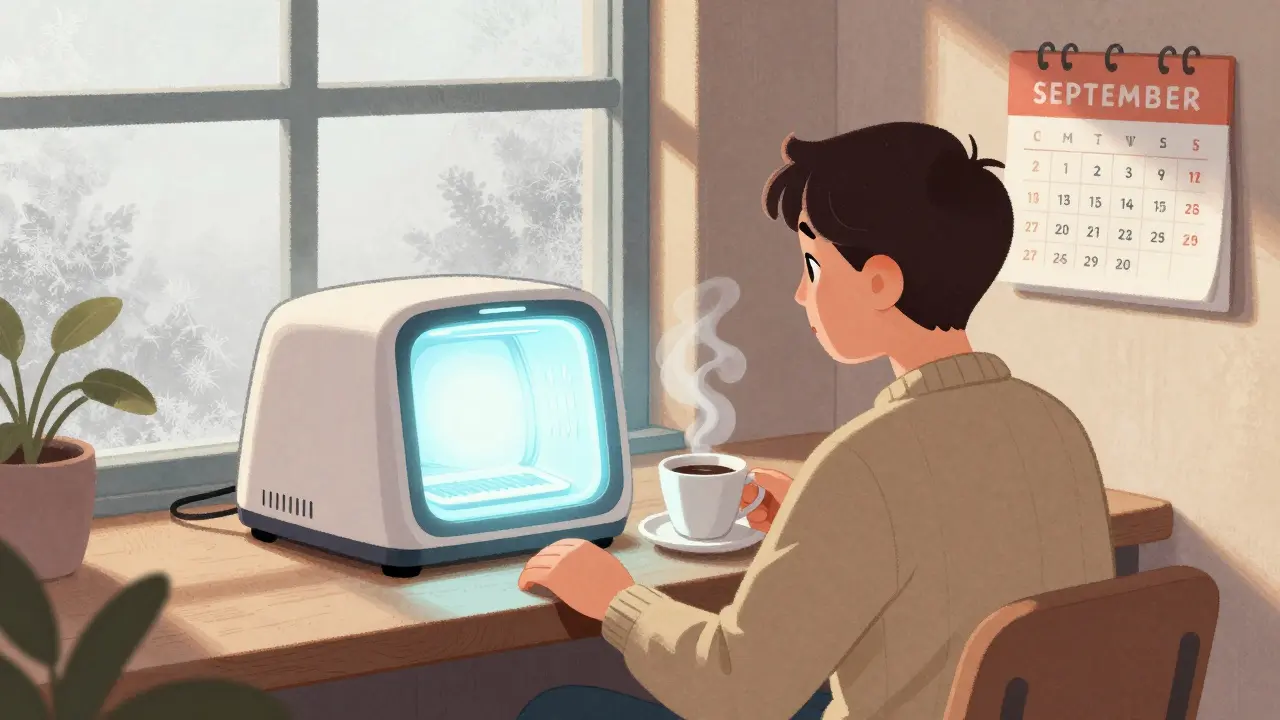
Every year, as days get shorter and the sun disappears before dinner, millions of people feel a shift they can’t quite explain. It’s not just being tired. It’s losing interest in things you used to love. Waking up exhausted, even after eight hours of sleep. Craving carbs, gaining weight, and feeling like you’re moving through fog. This isn’t laziness. It’s not just "winter blues." It’s seasonal depression - clinically called major depressive disorder with seasonal pattern. And the good news? You don’t have to wait for it to hit before you act.
Why Seasonal Depression Happens (And Why It’s Different)
Seasonal depression isn’t caused by cold weather or holiday stress. It’s caused by light. Specifically, the lack of it. When sunlight drops in fall and winter, your body’s internal clock - your circadian rhythm - gets thrown off. That clock controls everything: when you sleep, when you wake, when you feel alert, and even how your brain makes mood chemicals like serotonin and melatonin.
Research from the National Institute of Mental Health shows that people with seasonal depression have lower serotonin activity during winter months. At the same time, their bodies produce too much melatonin - the sleep hormone - because it’s dark for longer. That’s why you feel sleepy all day but can’t fall asleep at night. It’s not your fault. It’s biology.
And it’s predictable. Unlike other types of depression, seasonal depression follows a strict annual cycle. Symptoms usually start in late September or October and lift by March or April. That predictability is your advantage. You can prepare.
Light Therapy: The Most Proven Tool
If you do one thing to prevent seasonal depression, make it light therapy. Not just going outside. Not just turning on a bright lamp. You need a specific device: a light box that emits 10,000 lux of light, with minimal UV and strong blue wavelengths (460-480 nm).
Here’s how to use it right:
- Use it within the first hour of waking up - ideally before 8 a.m.
- Place it 16 to 24 inches from your face. You don’t need to stare at it. Read, drink coffee, or check emails while it’s on.
- Use it for 20 to 30 minutes every day. Don’t skip days.
Studies from the Mayo Clinic show 70% of users feel better within 1 to 2 weeks. That’s faster than most antidepressants. And unlike medication, it has almost no side effects.
But timing matters more than intensity. Using it at noon won’t help as much as using it in the morning. Why? Because morning light resets your internal clock. If you use it too late, you might end up waking up even earlier - which defeats the purpose.
Some newer devices, like the Bodyclock Start 10000 released in early 2025, simulate a natural sunrise. They slowly brighten over 90 minutes, mimicking the light pattern of early May - the time when most people naturally start feeling better. These are especially helpful if you struggle to wake up.
Vitamin D: Helpful, But Only If You’re Deficient
You’ve probably heard that vitamin D helps with mood. That’s true - but only if you’re low.
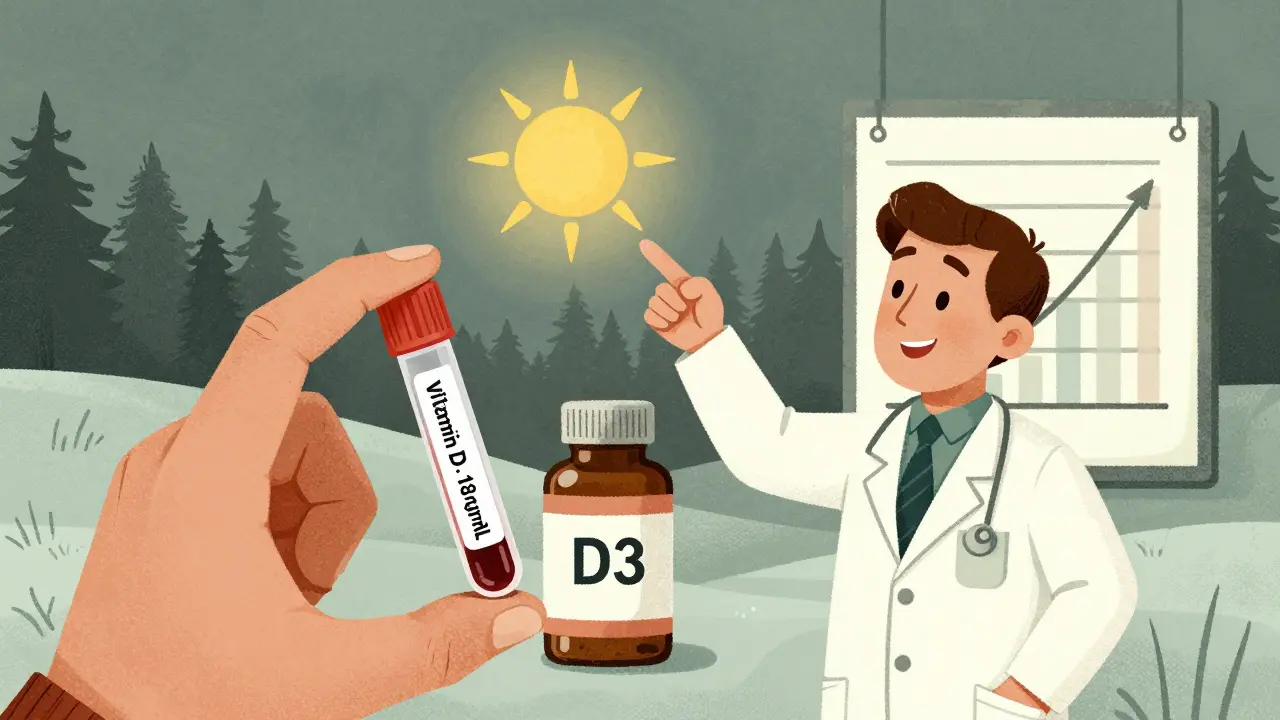
Research from UC Davis Health and the Endocrine Society shows that people with vitamin D levels below 20 ng/mL are at higher risk for depression. If your levels are normal, taking extra won’t help. That’s why testing is critical.
Here’s what to do:
- Get a blood test in early fall - don’t wait until you feel bad.
- If your level is below 20 ng/mL, take 5,000 IU of vitamin D3 daily.
- If it’s between 20-30 ng/mL, take 2,000 IU daily.
- Re-test after 3 months to make sure you’re in the healthy range (30-50 ng/mL).
Don’t just grab any supplement. Look for D3 (cholecalciferol), not D2. D3 is the form your body naturally makes from sunlight. And pair it with a meal that has fat - it helps absorption.
Some experts, like Dr. Uma Naidoo at Harvard, also recommend adding omega-3s from salmon, walnuts, or fish oil. These fats support brain function and may boost serotonin. Tryptophan-rich foods - eggs, chicken, spinach, bananas - help too. They’re building blocks for serotonin.
But vitamin D alone won’t fix seasonal depression. A 2024 study in the American Journal of Psychiatry found that people who took D3 without fixing their light exposure or routine saw little to no improvement. It’s a helper, not a cure.
Routine: The Silent Game-Changer
Here’s something most people overlook: your schedule is as important as your light box.
When your body doesn’t know when to expect light, it gets confused. That’s why sleeping in on weekends or napping after dinner makes seasonal depression worse. Your circadian rhythm needs consistency.
Follow these simple rules:
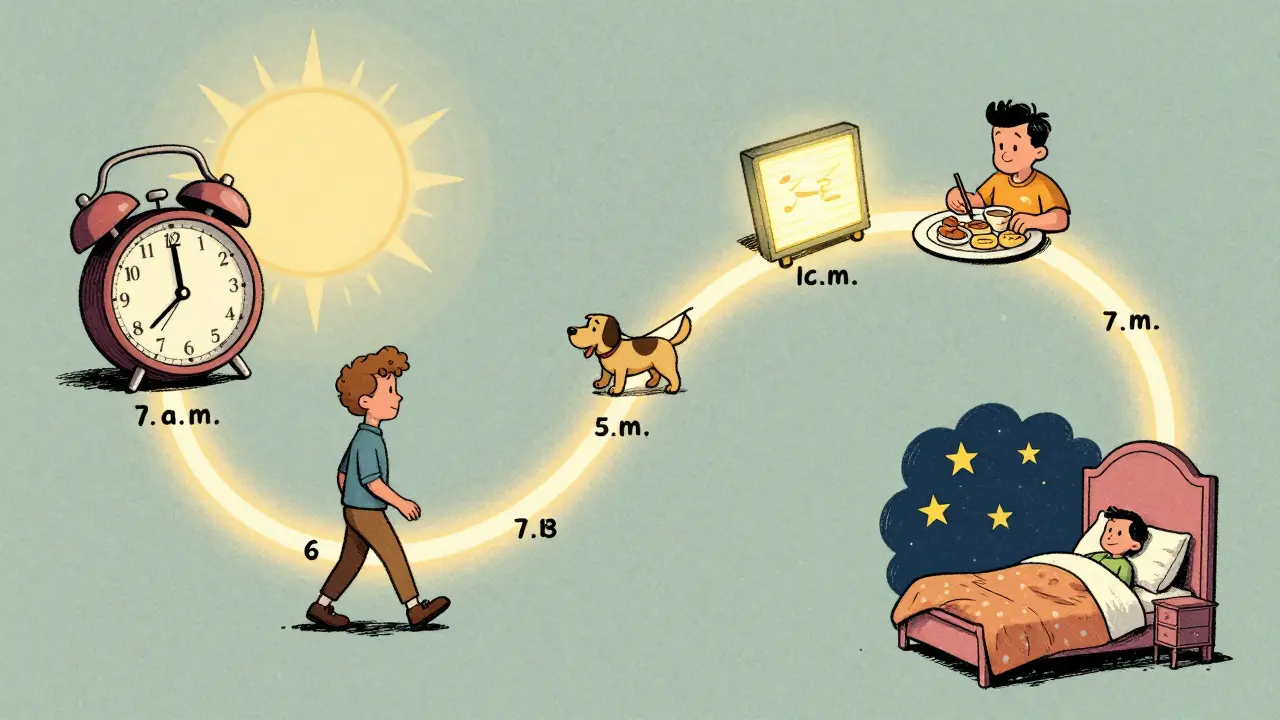
- Wake up at the same time every day - even on weekends. No more than 30 minutes variation.
- Get at least 5 to 10 minutes of natural sunlight within two hours of waking. Even on cloudy days, outdoor light is 10 to 20 times brighter than indoor lighting.
- Move your body for 30 minutes daily. Walk, stretch, dance - doesn’t matter. Just move.
- Stop napping after 3 p.m. And avoid oversleeping. Sleeping more than 9 hours can worsen fatigue.
Why does this work? Because routine stabilizes your body clock. When your brain learns to expect light, movement, and sleep at the same times every day, it stops panicking when days get short.
People who combine routine with light therapy are 30% more likely to avoid full-blown depression, according to Columbia University’s 2021 research. One patient, a teacher from Minnesota, told me: "I used to hate November. Now I set my alarm for 7 a.m. every day, walk my dog before work, and turn on my light box while I make coffee. I don’t feel like I’m fighting winter anymore. I’m just living through it."
What Works Best? The Evidence-Based Combo
Light therapy alone works well. But the best results come from combining it with routine and vitamin D.
A 2024 NIH-funded trial led by Columbia University’s Center for Environmental Therapeutics tested three groups:
- Group 1: Light therapy only
- Group 2: Light therapy + vitamin D
- Group 3: Light therapy + routine + vitamin D
After six weeks:
- Group 1: 52% symptom reduction
- Group 2: 58% symptom reduction
- Group 3: 73% symptom reduction
The combo group didn’t just feel better - they stayed better. Only 18% relapsed after winter ended, compared to 40% in the light-only group.
Even cognitive behavioral therapy for SAD (CBT-SAD), which helps people change negative thought patterns around winter, only reached 55% improvement in earlier studies. And while CBT lasts longer, it takes 4 to 6 weeks to start working. Light and routine work faster.
So here’s your simple plan:
- Start light therapy in early September - before symptoms begin.
- Take vitamin D3 based on your blood test results.
- Wake up at the same time every day. Get morning light (natural or artificial).
- Move your body daily. No excuses.
What Doesn’t Work (And Why)
Not all advice is equal. Here’s what you can ignore:
- "Just be positive." - Depression isn’t a mindset. It’s a biological response to light loss.
- "Take a vacation to Florida." - Temporary relief, but not prevention. You’ll still get sick when you return.
- "Use a regular LED lamp." - Most lamps don’t emit enough lux or the right wavelengths. You need a medical-grade light box.
- "Take 10,000 IU of vitamin D every day." - Too much can be toxic. Test first.
Also, don’t wait until you’re in crisis. If you’ve had seasonal depression before, start your prevention plan in August or early September. Waiting until November means you’re already behind.
Real People, Real Results
In Sweden, the government gives free light therapy boxes to anyone diagnosed with SAD. Since 2019, winter antidepressant prescriptions have dropped 22%. That’s not magic. That’s prevention.
Fortune 500 companies are catching on too. Nearly 40% now offer light therapy stations and flexible morning hours during winter. Why? Because employees are more focused, less absent, and less likely to burn out.
One woman in Seattle, who used to call in sick every December, started using a dawn simulator and walking her dog at 7 a.m. every day. She didn’t stop working. She didn’t need medication. She just changed her routine - and her life.
What’s Next? The Future of Prevention
In January 2025, the FDA approved the first digital therapy app for SAD prevention: SeasonWell. It delivers CBT-SAD through your phone, with reminders, mood tracking, and guided activities. In trials, 78% of users stuck with it - far higher than traditional therapy.
And climate change is making this more important. The Global Burden of Disease Study predicts a 12% rise in SAD cases by 2030 as winters become more unpredictable. But we’re not helpless. We have tools.
Seasonal depression is one of the few mental health conditions where prevention isn’t just possible - it’s highly effective. You don’t need to suffer through winter. You just need to act before it hits.
Can seasonal depression be prevented without medication?
Yes. For most people, a combination of light therapy, vitamin D (if deficient), and a consistent daily routine is enough to prevent or significantly reduce symptoms. Medication is usually only needed if symptoms are severe or if these methods don’t help after 4-6 weeks.
Do I need a prescription for a light therapy box?
No. Light therapy boxes are available over the counter. But make sure it meets medical standards: 10,000 lux, UV-free, and emits blue-enriched light (460-480 nm). Avoid cheap lamps or "mood lights" - they won’t work. Look for devices certified by the Center for Environmental Therapeutics.
How long does it take for light therapy to work?
Most people notice improvement within 3 to 7 days. Full benefits usually appear in 1 to 2 weeks. Consistency matters more than duration - use it daily, even if you feel fine.
Is vitamin D enough to treat seasonal depression?
Not on its own. Vitamin D helps only if your levels are low. Even then, it’s a supporting player. Light therapy and routine are the main tools. Think of vitamin D like a tire pressure light - it tells you something’s off, but fixing it requires more than just adding air.
What if I live in a place with very little sunlight in winter?
You’re even more at risk - and more likely to benefit. People in Alaska, Canada, and northern Europe have higher rates of seasonal depression. That’s why light therapy is so critical there. Combine it with morning walks, even if it’s cloudy, and keep your schedule rock-solid. Some people in these areas use dawn simulators to mimic sunrise during the darkest weeks.
Can I use sunlight instead of a light box?
Yes - but only if you can get outside within two hours of waking and it’s bright enough. On a clear winter day, outdoor light can be 10,000 lux or more. On a cloudy day, it’s only 1,000-2,000 lux. That’s not enough for most people. A light box gives you reliable, controlled exposure - no weather required.
Should I start prevention in August or wait until September?
Start in August. Symptoms usually begin in late September or October. By starting early, you’re not treating depression - you’re preventing it. The earlier you begin light therapy and routine, the less severe your symptoms will be - or if you’re lucky, you won’t get them at all.


Write a comment
Your email address will be restricted to us