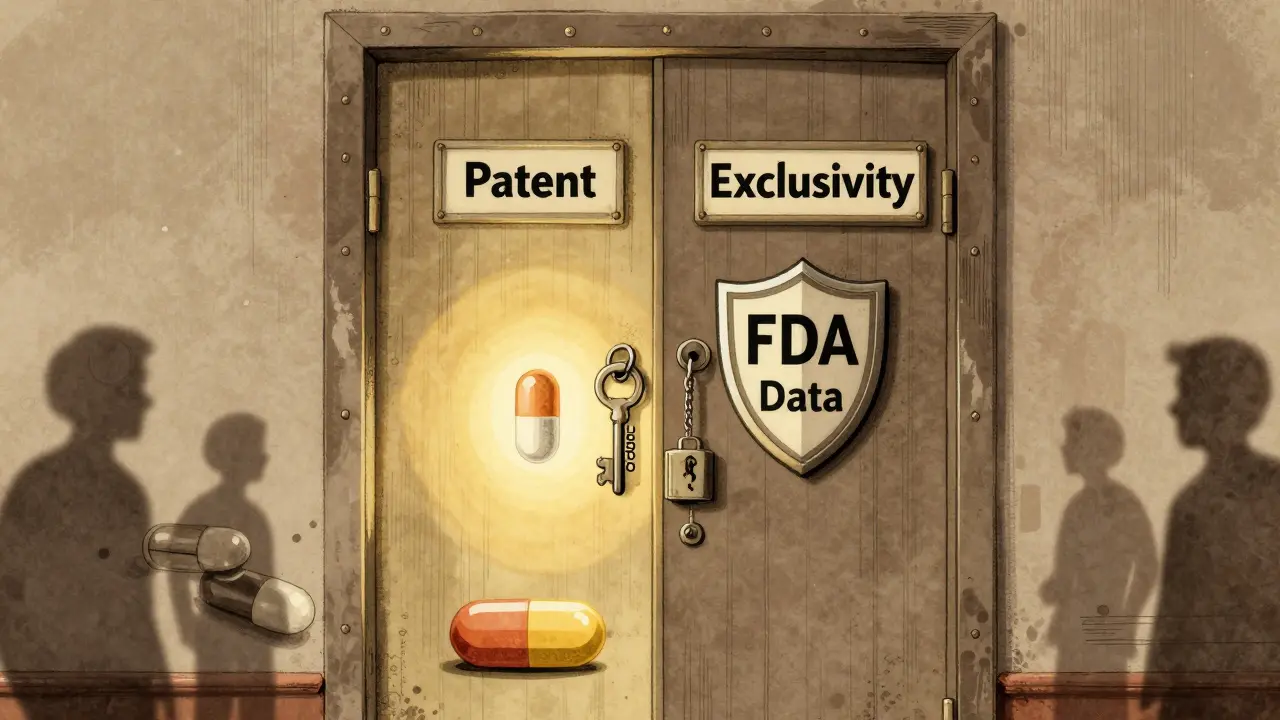
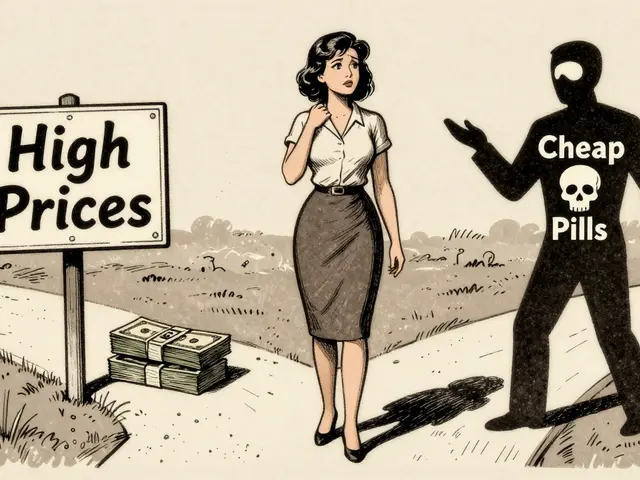
Imagine a new drug hits the market. It costs $500 a pill. Five years later, a generic version appears for $2. Why the wait? Why not sooner? The answer isn’t just about patents. It’s about two different kinds of protection - one from the patent office, the other from the FDA. And they don’t work the same way.
Patent Exclusivity: The Legal Lock
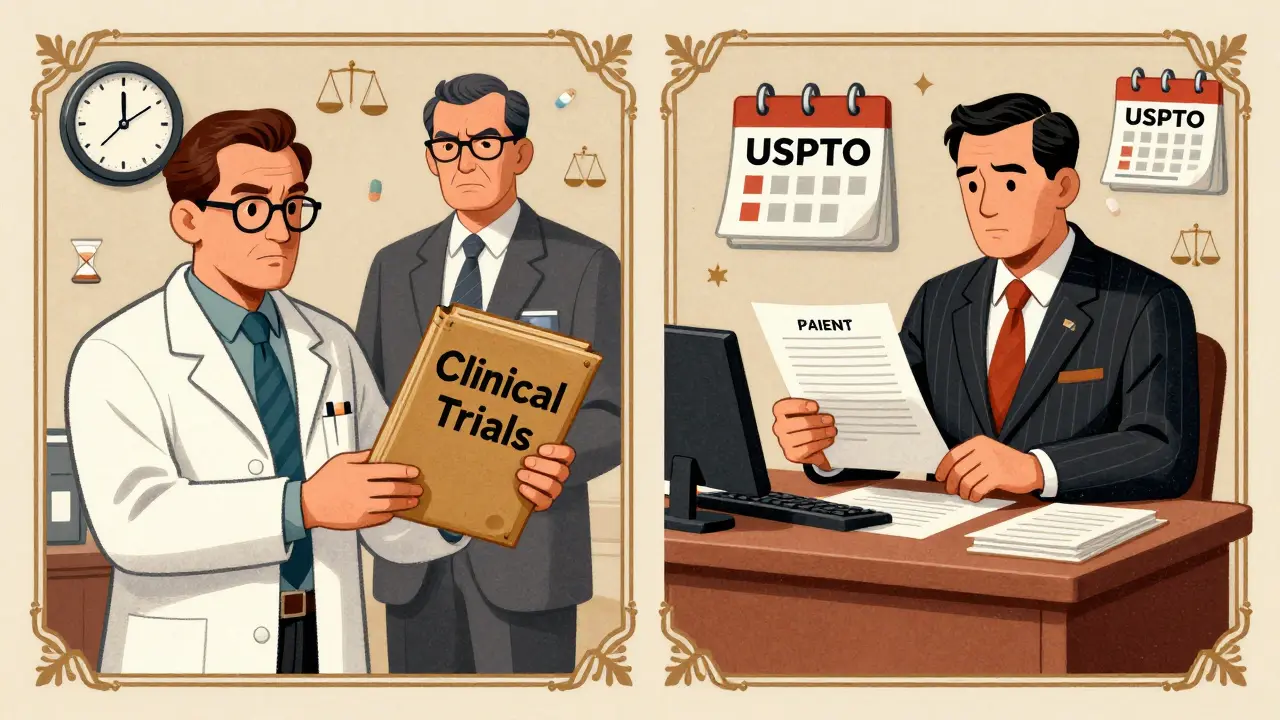
A patent is a legal right granted by the United States Patent and Trademark Office (USPTO) a federal agency that issues patents and trademarks in the United States. It gives the inventor the right to stop others from making, selling, or using their invention for 20 years from the filing date. In pharma, that invention could be a new molecule, a way to make it, or how it’s used in the body.
But here’s the catch: patents are filed years before a drug gets approved. The average drug takes 10 to 15 years to go from lab to pharmacy shelf. So by the time the FDA says yes, you’ve already used up half your patent life. That’s why companies often get extensions - Patent Term Extension (PTE) a legal mechanism that adds time to a patent to compensate for regulatory review delays. The law lets them add up to five extra years, but the total market life can’t go beyond 14 years after approval.
Patents aren’t automatic shields. You have to sue to enforce them. If a generic company says, "We’re not breaking your patent," the brand-name company has to prove otherwise in court. That’s expensive, slow, and uncertain. Many patents end up being challenged - especially the weaker ones, like methods of use or pill coatings. In fact, 68% of patents listed in the FDA’s Orange Book are secondary patents, not the core molecule.
Market Exclusivity: The FDA’s Gate
Market exclusivity is not about invention. It’s about data. It’s the Food and Drug Administration (FDA) the U.S. government agency responsible for regulating food, drugs, medical devices, and cosmetics saying: "You spent millions on clinical trials. We won’t let anyone else use your data to get approved for five, seven, or twelve years."
This is enforced automatically. No lawsuit needed. If you submit a new drug application (NDA) and meet the rules, the FDA cannot approve a generic version until the exclusivity period ends. Even if the patent has expired.
There are different types:
- New Chemical Entity (NCE) exclusivity: 5 years. No one can even submit a generic application during this time.
- Orphan drug exclusivity: 7 years. For drugs treating rare diseases (under 200,000 patients in the U.S.).
- Pediatric exclusivity: +6 months. Added to existing patent or exclusivity if the company studies the drug in children.
- Biologics exclusivity: 12 years. For complex protein-based drugs like Humira or Enbrel.
- 180-day exclusivity: Given to the first generic company that successfully challenges a patent. They get a head start on the market.
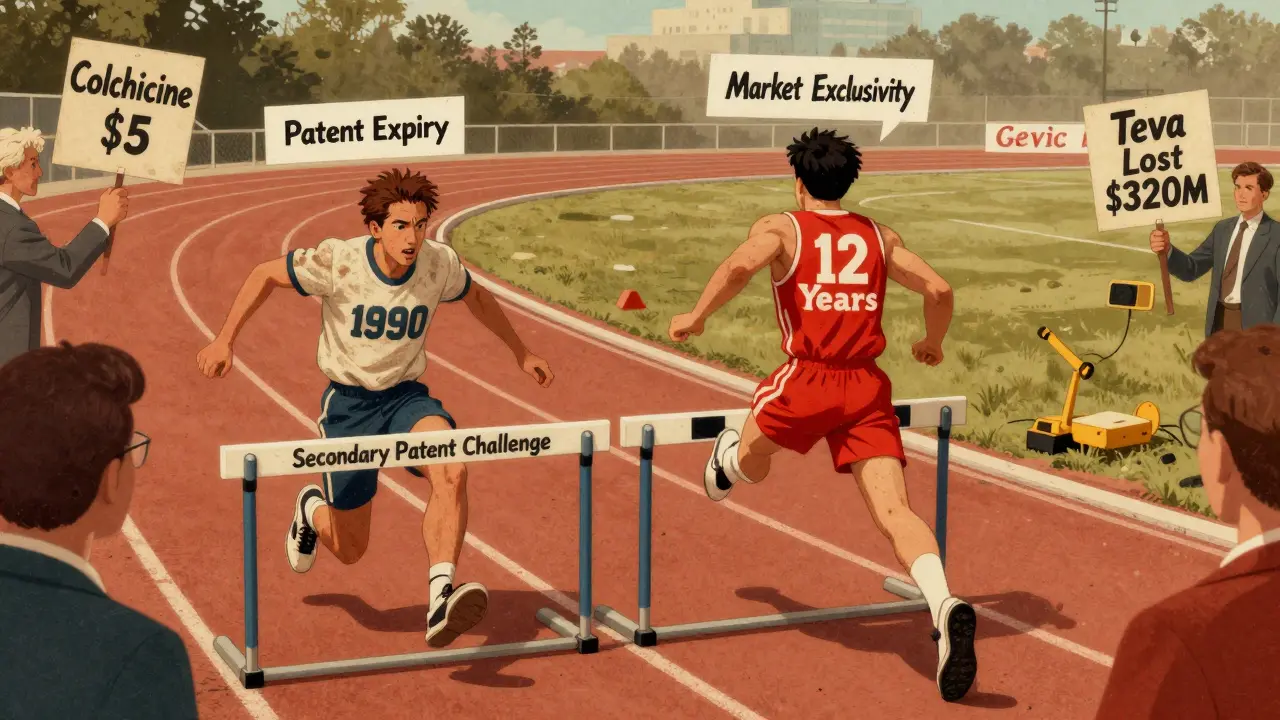
Here’s the kicker: You can have market exclusivity without a patent. In 2010, a drug called colchicine - used since ancient Egypt - got 10 years of exclusivity because a company submitted new clinical data. The price jumped from 10 cents to $5 per pill. No patent. Just exclusivity.
Why Both Exist: A Double Lock System
Patents and market exclusivity aren’t the same. They don’t even come from the same agency. Patents come from USPTO. Exclusivity comes from FDA. One protects the invention. The other protects the investment in proving it works.
Think of it like a house with two locks. One lock is the key you hold (patent). The other is a code the guard at the gate won’t let anyone else use (exclusivity). You can have one without the other. Or both.
According to FDA data from 2021:
- 27.8% of branded drugs had both patent and exclusivity
- 38.4% had only patents
- 5.2% had only exclusivity
- 28.6% had neither
That 5.2%? Those are drugs with no patent protection at all - but still blocked from generics. That’s market exclusivity doing the heavy lifting.
Real-World Impact: When Exclusivity Blocks Competition
Generic companies don’t just wait for patents to expire. They watch exclusivity like a countdown clock.
Take Trintellix, an antidepressant. Its patents expired in 2021. But the FDA granted three years of exclusivity. So even though the patent was gone, no generic could enter until 2024. Teva Pharmaceuticals lost an estimated $320 million because of it.
Small biotech firms often get this wrong. A 2022 survey by the Biotechnology Innovation Organization found 43% of them assumed patent = market protection. They didn’t file for exclusivity. Lost time. Lost money. Average cost: $1.7 million per mistake.
And it’s not just about money. The FDA’s own data shows 22% of innovator companies didn’t claim all available exclusivity between 2018 and 2022. On average, they left 1.3 years of protection on the table. That’s free time - free revenue - thrown away.
Global Differences: What’s Happening Elsewhere
The U.S. isn’t the only player. The European Union gives 8 years of data exclusivity, plus 2 years of market exclusivity, and another year if the drug gets a new use. That’s 11 years total - longer than the U.S. for some drugs.
And now, global pressure is mounting. The World Trade Organization considered waiving patent rights for COVID vaccines. Similar debates are starting for other medicines. If those waivers spread, both patent and exclusivity systems could change.
Meanwhile, the FDA launched its Exclusivity Dashboard in September 2023. Now anyone can see exactly when each drug’s exclusivity ends. That’s transparency - but it also means generic makers are ready to pounce the moment the clock hits zero.
Who Benefits? Who Pays?
The system was designed to balance innovation and access. New drugs cost $2.3 billion on average to develop. Without protection, companies couldn’t recoup that. But protection also means higher prices for longer.
Branded drugs make up just 12% of prescriptions in the U.S. but 68% of total spending. Why? Because they’re the only option during exclusivity. The first year after launch? That’s when most of the revenue happens - 65% of a drug’s lifetime earnings, according to Evaluate Pharma.
Pediatric exclusivity alone has generated $15 billion in extra revenue since 1997. The 180-day first-generic window? Worth $100 million to $500 million for the company that wins it.
But when exclusivity runs too long - especially for old drugs with no real innovation - patients pay. And taxpayers pay more through Medicare and Medicaid.
What’s Changing? The Future of Drug Protection
By 2027, McKinsey predicts regulatory exclusivity will account for 52% of total drug protection time - up from 41% in 2020. Why? Because patents are getting weaker. Courts are striking down secondary patents. Companies are shifting focus to exclusivity.
The PREVAIL Act of 2023 proposes cutting biologics exclusivity from 12 to 10 years. That’s a big deal. Biologics are the fastest-growing segment of the drug market.
And the FDA’s new rules, starting January 1, 2024, require companies to give more detailed reasons for claiming exclusivity. No more vague claims. If you want that extra five years, you’ll have to prove it.
For generic manufacturers, this is good news. More transparency. Fewer hidden barriers. For brand companies? It’s a warning: don’t assume exclusivity is automatic. File it right. Or lose it.
Key Takeaways
- Patents protect inventions. Market exclusivity protects clinical data.
- Patents are enforced in court. Exclusivity is enforced by the FDA - no lawsuit needed.
- You can have exclusivity without a patent. The colchicine case proves it.
- Exclusivity periods vary: 5 years for new chemicals, 7 for orphan drugs, 12 for biologics.
- Companies often miss out on exclusivity - and lose millions because of it.
- By 2027, exclusivity will likely be the main barrier to generic entry, not patents.
Can a drug have market exclusivity without a patent?
Yes. Market exclusivity is granted by the FDA based on the data submitted for approval, not on whether a patent exists. For example, the drug colchicine received 10 years of exclusivity despite having no active patent - because the company submitted new clinical studies for an old drug. The FDA blocked generics for that entire period.
How long does patent protection last for drugs?
Patents last 20 years from the filing date. But because drug development takes 10-15 years, the actual market protection is often only 10-12 years. Companies can apply for Patent Term Extension (PTE) to add up to 5 years, but total protection after approval can’t exceed 14 years.
What’s the difference between data exclusivity and market exclusivity?
Data exclusivity means generic companies can’t use your clinical trial data to support their application. Market exclusivity means the FDA won’t approve any competing product at all - even if they do their own studies. In the U.S., NCE exclusivity is both data and market exclusivity for 5 years. In the EU, they’re separate: 8 years data, 2 years market.
Why do generic companies care about the 180-day exclusivity?
The first generic company to successfully challenge a patent gets 180 days of exclusive market access. During that time, no other generic can enter. That’s a huge financial advantage - often worth $100 million to $500 million in extra revenue. It’s why companies spend millions on legal battles to be first.
Do patents and exclusivity always end at the same time?
No. They can overlap, end at the same time, or one can outlast the other. For example, a drug’s patent might expire in 2023, but its 5-year exclusivity runs until 2026. That means no generic can enter until 2026, even though the patent is gone. The FDA enforces the longer protection.
Is market exclusivity only for new drugs?
No. While New Chemical Entity exclusivity is for brand-new molecules, other types like orphan drug exclusivity (7 years) or pediatric exclusivity (+6 months) can apply to existing drugs if new studies are done. Even old drugs can get exclusivity if they’re reformulated or studied for new uses.


Write a comment
Your email address will be restricted to us