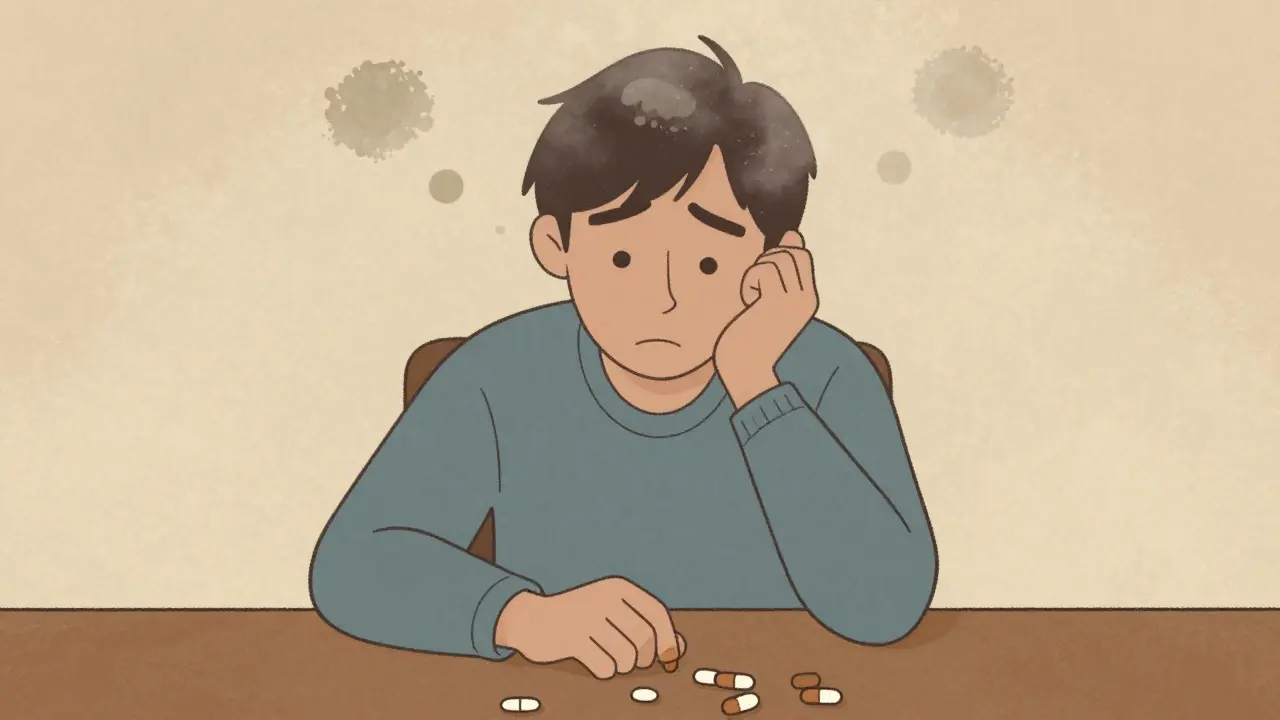
If you have been prescribed medication for anxiety or sleep, you might know them by their brand names-Xanax, Valium, Ativan. These belong to a family of drugs called Benzodiazepines is a central nervous system depressant medication class used primarily for treating anxiety, insomnia, and seizure disorders. Also known as benzos, they work by enhancing the effect of gamma-aminobutyric acid (GABA), a chemical that calms brain activity. While they help millions manage acute stress, there is a quieter conversation happening about what happens when you stay on them for years.
We often get so focused on fixing the anxiety that we forget how the fix itself changes us. Think of your daily life for a moment. Have you noticed you misplace your keys more often? Or perhaps you feel slightly off-balance when walking across a room. These aren't necessarily signs of aging; they could be side effects lurking behind the prescription pad. This isn't meant to scare you away from treatment you need, but to give you the clarity to weigh the pros and cons honestly.
The Hidden Cost to Your Memory
One of the most documented impacts of long-term use involves how your brain stores information. It’s not just about forgetting where you put your glasses; it runs deeper than that. When you take these medications, they interfere with a part of your brain called the hippocampus. This area is responsible for turning short-term thoughts into permanent memories.
Research shows that people using these drugs over the long term face a measurable drop in cognitive sharpness. A large review of studies found that current users experienced significant reductions in working memory and processing speed. Specifically, the effect size indicates a meaningful gap compared to non-users. In practical terms, this means tasks that used to feel automatic now require more mental effort. You might find yourself struggling to concentrate on a conversation or losing your train of thought mid-sentence.
This effect creates something doctors call anterograde amnesia. It is the inability to form new memories while the drug is active in your system. Imagine trying to write on a piece of paper where the ink keeps smudging before it dries. That is essentially what happens to your learning process while on the medication. Studies suggest that while some tolerance develops to the sedative effects, the impact on memory formation does not fade away as easily.
| Function | Observed Change | Impact on Daily Life |
|---|---|---|
| Working Memory | Decrease of approx. 50% | Holding multiple items in mind becomes harder |
| Processing Speed | Slowed reaction time | Taking longer to understand news or instructions |
| Visuoconstruction | Impaired spatial reasoning | Difficulty navigating unfamiliar routes |
Here is the part many people miss. Even after you stop taking the medication, the fog doesn't always lift immediately. Data following patients six months after discontinuation showed continued dysfunction in recent memory and divided attention. Some longitudinal studies tracking patients for ten months found that only about 45% returned to completely normal functioning levels, meaning more than half still struggled with residual cognitive issues. It highlights why understanding your baseline before starting, or monitoring closely while on treatment, matters.
The Balance Problem: Falls and Fractures
Your memory might worry you, but your physical safety faces a more immediate threat. We are seeing a very strong connection between these medications and falls, especially for anyone over the age of 65. If you think of balance as a tightrope walk, benzodiazepines effectively widen the rope until you’re less stable.
A meta-analysis covering 1.2 million participants calculated that current use increases the risk of falling by 50%. That number jumps significantly when looking at high-potency drugs like alprazolam or lorazepam. These stronger varieties were linked to a 60% higher risk compared to lower potency options. The mechanism here is straightforward: the medication slows down your reaction time and affects postural stability. You don’t just trip; your brain takes longer to tell your legs to correct the stumble.
The consequences of a fall are severe. For older adults, a broken hip is often the starting point of a long recovery or permanent loss of independence. The American Geriatrics Society has placed these drugs on their "Beers Criteria" list of potentially inappropriate medications for older adults specifically because of this danger. They contribute to roughly 93,000 emergency department visits annually just from fall-related injuries in the US alone.
Consider the scenario of getting up to answer the door at night. If you take a nighttime dose for sleep, you are at peak sedation level in the middle of the night when you are naturally groggy. Adding the drug's muscle-relaxing effects creates a perfect storm for an accident. It is often the combination of the environment, fatigue, and the medication that triggers the incident, making prevention crucial.

Navigating Tapering Safely
If you have realized the benefits no longer outweigh the risks, stopping abruptly is never the answer. Withdrawing too fast can cause seizures, rebound anxiety, or severe perceptual disturbances. The body builds up a tolerance, and suddenly removing the chemical support leaves a void that needs to be filled gradually.
The gold standard for managing this process is known as the Ashton Protocol is a method for withdrawing from benzodiazepines developed by Professor C. Heather Ashton that recommends slow, gradual reduction to minimize withdrawal symptoms. It suggests reducing the dose by about 5 to 10% of the current amount every 1 to 2 weeks. This pace allows your brain receptors to recalibrate to functioning without the constant presence of the drug.
A randomized trial involving over 300 users found that switching to diazepam for the tapering phase achieved a 68.5% success rate. Why diazepam? It has a long half-life, meaning it leaves the bloodstream slowly. This creates a smoother curve for your blood levels compared to shorter-acting drugs which spike and crash rapidly, causing more discomfort. The study noted that cognitive improvements actually started appearing as early as four weeks into the taper.
It is important to listen to your body during this time. In clinical trials, about 22% of patients had to pause their taper to stabilize for a few weeks because symptoms became too intense. This is not failure; it is part of the adjustment process. Rushing the timeline usually leads to relapse or restarting the cycle. Patience is the most vital ingredient here.

Is Long-Term Use Ever Worth It?
Medical guidelines generally advise keeping these prescriptions short-term, ideally under four weeks for anxiety. However, real-world usage tells a different story. Approximately 12.6% of adults fill at least one prescription annually, and many use them for years. Experts debate whether the trade-off makes sense for everyone.
Some researchers note individual differences. About 30% of patients over 65 show minimal cognitive impairment despite long-term use, suggesting genetic factors or other protective elements might play a role. However, the general consensus remains cautious. New research is exploring alternative compounds that target specific parts of the GABA receptor to provide relief without the heavy cognitive cost. Until these become widely available, careful monitoring is your best defense.
Doctors recommend regular screening. Tools like the Montreal Cognitive Assessment can help track your thinking skills over time. If you see a dip in your scores, it serves as an early warning sign to adjust the dosage or discuss alternatives. You shouldn't have to guess if your memory loss is normal or drug-induced.
Can benzodiazepines permanently damage my brain?
While studies show no permanent structural abnormalities, functional deficits can persist for months after stopping. Full recovery varies by individual, with about 45% returning to baseline after a year, but some residual impairment is possible.
What is the safest way to stop taking benzos?
The recommended approach is the Ashton Protocol, involving slow tapering of 5-10% every 1-2 weeks. Switching to a longer-acting medication like diazepam before tapering often yields better results and fewer symptoms.
How do these drugs affect my risk of falling?
Current use increases fall risk by approximately 50%. High-potency variants increase this risk further. The medication impairs balance and slows reaction times, making slips much more dangerous, especially at night.
Will my memory improve after I stop?
Improvement often begins around 4 to 8 weeks into the tapering process. Many report significant gains in processing speed and attention, though full recovery can take up to 6-12 months post-discontinuation.
Are there alternatives to benzodiazepines for anxiety?
Yes. Non-drug therapies like CBT are highly effective. Emerging medications targeting specific receptor subtypes are in development. Always consult your doctor to explore SSRIs or non-habit-forming treatments.






Write a comment
Your email address will be restricted to us