
Imagine walking into a pharmacy with a prescription for a blood pressure medication. The pharmacist doesn't just grab the first pill bottle they see. They check a complex web of codes, names, and legal categories to ensure you get the right drug, at the right cost, and in compliance with the law. This isn't magic; it's the result of generic drug classifications, which are systematic frameworks used to categorize pharmaceutical compounds based on therapeutic application, chemical structure, mechanism of action, and legal status. Without these systems, healthcare would be chaotic, error-prone, and dangerously inefficient.
We often think of drugs simply by their brand names or what they treat. But behind every generic name lies a structured identity. These classification systems bridge the gap between scientists who discover molecules, doctors who prescribe them, pharmacists who dispense them, and regulators who monitor them. In this guide, we'll break down the main types of drug classifications, how they differ, and why understanding them matters for your health and safety.
The Main Types of Drug Classification Systems
There is no single way to classify drugs because different stakeholders need different information. A doctor needs to know what condition a drug treats. A scientist needs to know how it interacts with cells. A lawyer needs to know if it's controlled. An insurance company needs to know how much it costs. Consequently, several distinct classification systems operate side-by-side.
| Classification Type | Primary Focus | Key Authority/Body | Best Used For |
|---|---|---|---|
| Therapeutic | Medical condition treated | FDA, USP, AHFS | Clinical prescribing & hospital formularies |
| Pharmacologic | Mechanism of action (how it works) | NCBI, Scientific Literature | Research & understanding biological effects |
| Legal (Controlled Substances) | Abuse potential & medical utility | DEA (USA), WHO | Regulatory compliance & law enforcement |
| Anatomical Therapeutic Chemical (ATC) | Anatomical group + therapeutic + chemical | WHO | Global statistical analysis & epidemiology |
| Insurance Tiers | Cost & formulary preference | Private Insurers (e.g., Humana) | Patient out-of-pocket costs & coverage |
Therapeutic Classification: Treating the Condition
This is the most common system you'll encounter in a clinical setting. Therapeutic classification organizes medications based on the specific medical conditions they are intended to treat. For example, instead of grouping all "heart drugs" together broadly, this system divides them into subcategories like Antihypertensives (for high blood pressure), Antiarrhythmics (for irregular heartbeats), and Cardiac Glycosides (for heart failure).
The FDA and the United States Pharmacopeia (USP) maintain the primary guidelines for this approach. According to the FDA's 2023 update, therapeutic classification remains the most clinically relevant method because it aligns directly with patient symptoms and diagnoses. If a patient presents with chest pain, a doctor looks under "Analgesics" or "Cardiovascular Agents," not under a complex chemical category.
Pros:
- Highly intuitive for clinicians making quick decisions.
- Reduces medication errors by standardizing terminology around diseases rather than chemistry.
- Used by 92% of U.S. hospitals, ensuring consistency across care settings.
Cons:
- Struggles with multi-indication drugs. Aspirin, for instance, is an analgesic (pain reliever) but also an anticoagulant (blood thinner). Placing it in one box ignores its other vital uses.
- Does not explain why a drug works, only what it does.
Pharmacologic Classification: Understanding the Mechanism
If therapeutic classification asks "What does it treat?", pharmacologic classification asks "How does it work?" This system groups drugs by their mechanism of action, which is the specific biochemical interaction through which a drug substance produces its pharmacological effect.
For example, within the broad category of antidepressants, pharmacologic classification distinguishes between Selective Serotonin Reuptake Inhibitors (SSRIs) like fluoxetine and Serotonin-Norepinephrine Reuptake Inhibitors (SNRIs) like venlafaxine. Both treat depression, but they affect different neurotransmitters in the brain. Understanding this distinction helps doctors manage side effects and drug interactions more effectively.
This system is heavily used in research and advanced clinical practice. The National Center for Biotechnology Information (NCBI) documents over 1,200 distinct pharmacologic classes. While scientifically rigorous, it requires significant education to navigate. A general practitioner might not need to know that a specific cancer drug is a "Tyrosine Kinase Inhibitor," but an oncologist will find that detail critical for selecting the right treatment for a specific tumor type.
Legal Classification: The DEA Schedules
In the United States, the Drug Enforcement Administration (DEA) classifies drugs based on their potential for abuse and whether they have accepted medical use. This is known as the Controlled Substances Act, which implements a five-schedule legal classification system based on abuse potential and medical utility. This system has nothing to do with therapeutic benefit and everything to do with regulation.
- Schedule I: High abuse potential, no accepted medical use (e.g., heroin, LSD, marijuana federally).
- Schedule II: High abuse potential, but with accepted medical use (e.g., oxycodone, fentanyl, Adderall). Prescriptions cannot have refills.
- Schedule III: Moderate to low abuse potential (e.g., products containing less than 15mg of codeine per dose, testosterone).
- Schedule IV: Low abuse potential (e.g., Xanax, Valium).
- Schedule V: Lowest abuse potential (e.g., cough syrups with small amounts of codeine).
This classification creates strict rules for prescribing, dispensing, and storing medications. However, it is controversial. Critics argue that Schedule I designation for substances like marijuana impedes scientific research, despite evidence of therapeutic benefits for chronic pain and other conditions. As of late 2023, legislative efforts continue to reclassify certain substances, which could ripple through all other classification systems.
The Global Standard: WHO ATC System
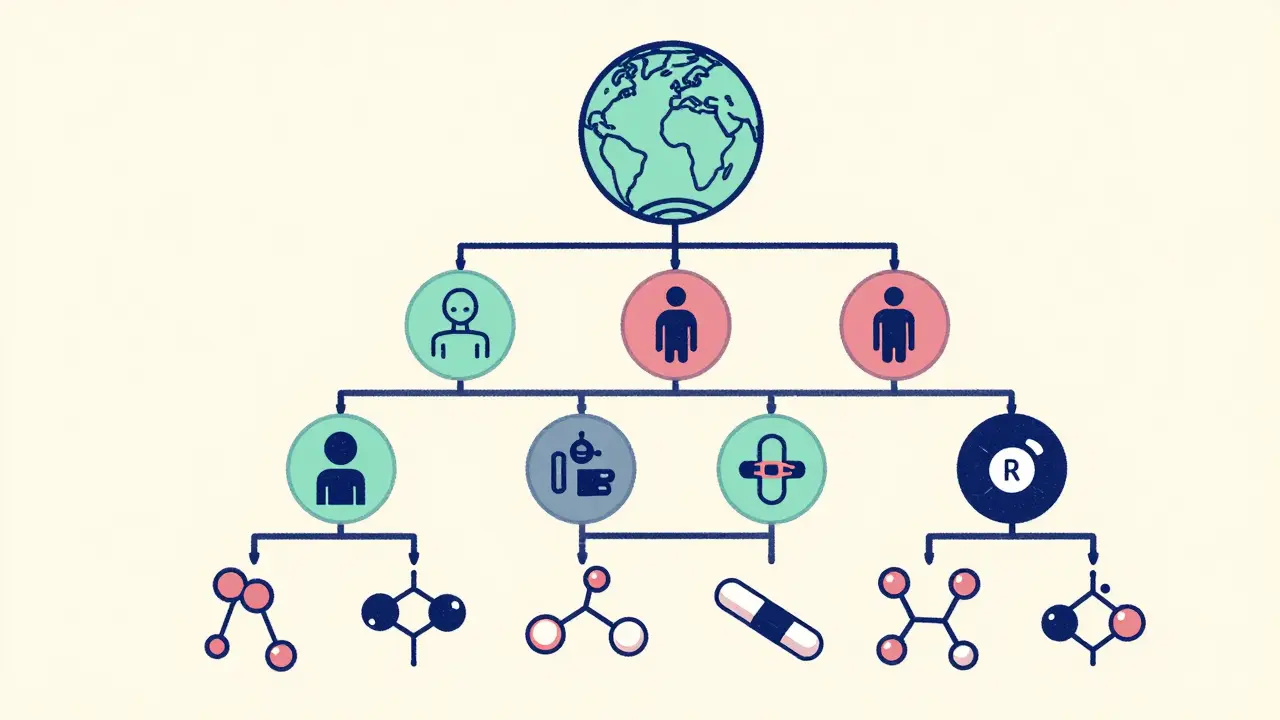
While the US relies heavily on FDA and DEA systems, the rest of the world largely follows the World Health Organization's Anatomical Therapeutic Chemical (ATC) classification system, which catalogs over 5,000 distinct substances across 14 main anatomical groups. The ATC system is hierarchical, starting with the anatomical group (which part of the body it affects), moving to the therapeutic subgroup, then the pharmacological subgroup, and finally the chemical substance.
For example, the drug omeprazole is classified as:
- A: Alimentary tract and metabolism
- A02: Drugs for acid-related disorders
- A02B: Drugs for ulcer disease
- A02BC: Proton pump inhibitors
- A02BC01: Omeprazole
This precision makes the ATC system invaluable for global health statistics and epidemiology. It allows researchers to compare drug usage patterns across countries, regardless of local brand names or regulatory differences. With 194 countries utilizing some form of standardized classification, the ATC system is the lingua franca of international pharmacovigilance.
Stem Naming Conventions: Clues in the Name
Have you ever noticed that many beta-blockers end in "-lol" (like propranolol or metoprolol)? Or that proton pump inhibitors end in "-prazole" (like omeprazole or pantoprazole)? This is not a coincidence. The stem naming convention, formally adopted by the USP in 1964, embeds pharmacological information directly into the generic name.
These stems serve as quick visual cues for healthcare providers. There are currently 87 distinct stems recognized in the USP Dictionary. While this system reduces medication errors by helping professionals identify drug classes at a glance, it struggles with newer biologic agents. Unlike small-molecule chemicals, biologics (like monoclonal antibodies) have complex structures that don't fit neatly into traditional chemical naming patterns, leading to new suffixes like "-mab" for monoclonal antibodies.
Insurance Tiers: The Economic Classification
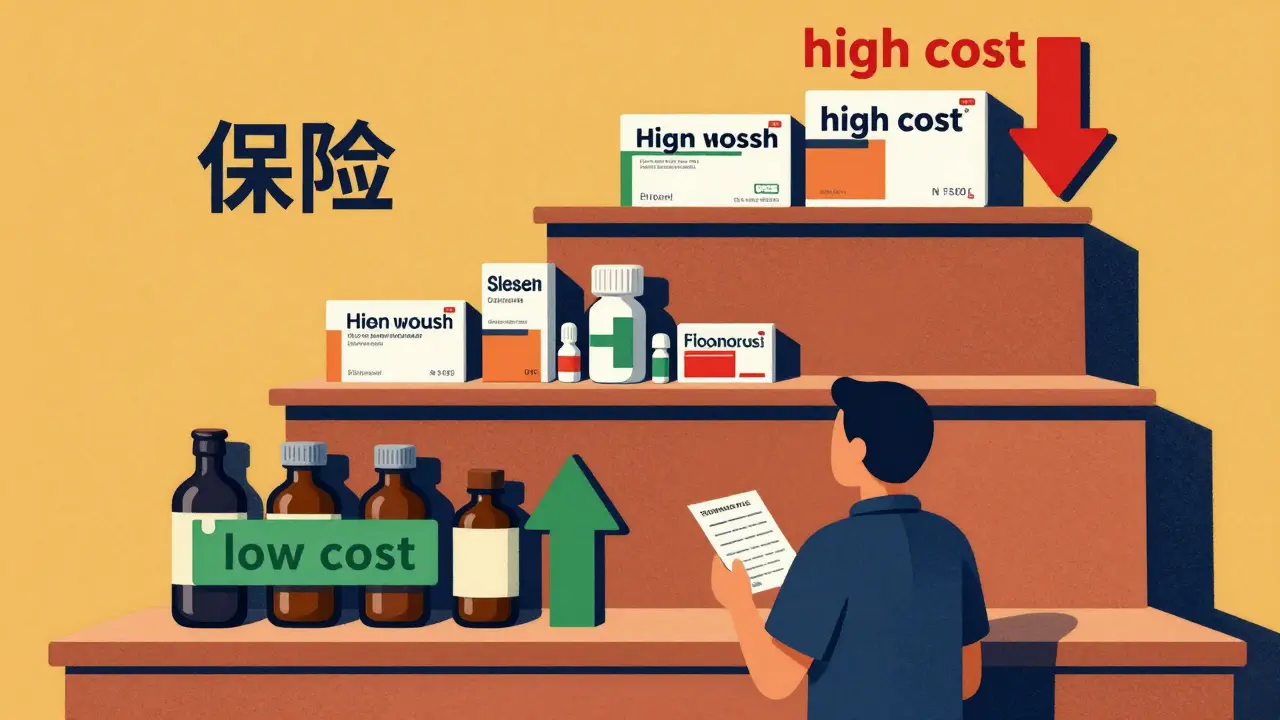
For patients, the most immediate classification is often financial. Insurance companies categorize drugs into tiers to manage costs. While therapeutic and pharmacologic classifications focus on health, insurance tier systems prioritize cost containment and formulary management.
A typical 5-tier plan might look like this:
- Tier 1: Preferred generics (lowest copay, covers ~75% of generic drugs).
- Tier 2: Non-preferred generics (slightly higher copay).
- Tier 3: Preferred brand-name drugs.
- Tier 4: Non-preferred brand-name drugs.
- Tier 5: Specialty medications (highest cost, often requiring prior authorization).
This system can create friction. A medically identical generic might be placed in Tier 2 while another is in Tier 1 due to formulary contracts rather than clinical differences. Pharmacists report that insurance tier disputes account for nearly half of all prior authorization requests, adding administrative burden to healthcare delivery.
Challenges and Future Directions
No classification system is perfect. The biggest challenge today is fragmentation. A single drug like buprenorphine is a Schedule III opioid legally, a partial mu-opioid agonist pharmacologically, and an addiction treatment therapeutically. Navigating these conflicting labels takes time and expertise. Studies show that primary care physicians spend 12-18 minutes per patient navigating these systems, contributing to clinician burnout.
Moreover, modern medicine is moving toward personalized treatments. Many new drugs have multimodal mechanisms of action, meaning they work in multiple ways simultaneously. Current rigid boxes struggle to accommodate this complexity. The FDA's upcoming Therapeutic Categories Model 2.0 aims to address this by allowing primary-secondary indication hierarchies, recognizing that one drug can legitimately belong to multiple therapeutic categories.
Artificial intelligence is also entering the space. Platforms like IBM Watson Health are using machine learning to predict optimal therapeutic placements with high accuracy. By 2028, analysts project that 65% of new molecular entities will require novel classification approaches. The future of drug classification will likely be hybrid, combining therapeutic, pharmacologic, and even genomic markers to provide a holistic view of each medication.
What is the difference between therapeutic and pharmacologic classification?
Therapeutic classification groups drugs by the medical condition they treat (e.g., antihypertensives for high blood pressure). Pharmacologic classification groups drugs by their mechanism of action (e.g., ACE inhibitors, which block a specific enzyme). Doctors use therapeutic classification for quick prescribing, while researchers and specialists use pharmacologic classification to understand biological effects and interactions.
Why are some generic drugs more expensive than others?
Even though generic drugs contain the same active ingredient as brand-name drugs, their cost varies based on insurance tier classifications. Insurers negotiate contracts with manufacturers, placing preferred generics in lower-cost tiers (Tier 1) and non-preferred ones in higher tiers (Tier 2). This economic classification drives patient out-of-pocket costs, not necessarily clinical differences.
How does the DEA schedule affect my prescription?
The DEA schedule determines legal restrictions. Schedule II drugs (like oxycodone) have high abuse potential and cannot have refills; you must get a new prescription each time. Schedule IV and V drugs may allow refills. These schedules dictate how pharmacies store, dispense, and track your medication to prevent diversion and abuse.
What is the ATC code and why does it matter?
The ATC (Anatomical Therapeutic Chemical) code is a global standard maintained by the WHO. It categorizes drugs by body part, therapeutic use, and chemical structure. It matters because it allows for consistent tracking of drug usage worldwide, aiding in public health research, safety monitoring, and comparing healthcare trends across different countries.
Can a drug belong to more than one classification?
Yes, absolutely. Most drugs have multiple classifications. For example, aspirin is therapeutically an analgesic and an anti-inflammatory, pharmacologically a COX inhibitor, and legally a non-controlled substance. Newer systems like the FDA's Model 2.0 are designed to better handle these multi-category identities to reduce confusion.





Write a comment
Your email address will be restricted to us