Quick Summary: Key Takeaways
- Special delivery systems require a "totality-of-the-evidence" approach, combining lab tests and human studies.
- Inhalers focus heavily on particle size (1-5 micrometers) and lung deposition.
- Transdermal patches prioritize release rates and skin adhesion over simple blood levels.
- Complex injectables, especially nanoparticles, demand strict physicochemical matching (e.g., zeta potential).
- Development costs for these products are 3-4 times higher than standard oral generics.
The Challenge of "Site of Action"
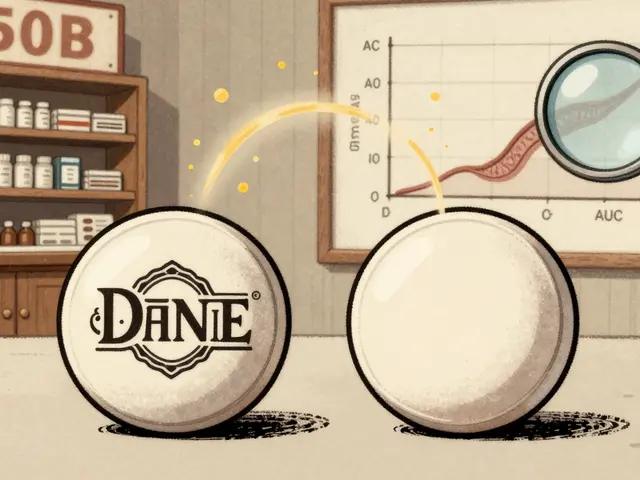
For a standard tablet, regulators look at the blood. If the concentration (Cmax) and the total exposure (AUC) in the plasma match the reference drug within a 80-125% window, you're usually good to go. But what happens when the drug isn't meant to travel through the whole body? If you're using a corticosteroid inhaler, the "site of action" is the lung tissue, not the bloodstream. Measuring plasma levels might tell you nothing about whether the drug actually reached the bronchioles.
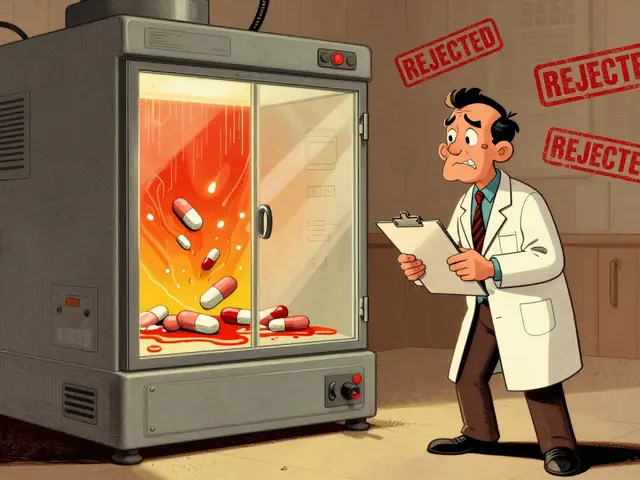
This shift moves the goalposts from simple pharmacokinetics to a more complex mix of physicochemical properties and pharmacodynamics. Regulatory bodies like the FDA and the EMA now demand a deeper dive. They want to see that the generic doesn't just have the same drug, but that the way it gets into the body is identical. This is why the approval rate for complex generics is significantly lower-around 47% compared to 78% for simple tablets.
Inhalers: Precision in Every Breath
Pulmonary delivery is perhaps the most stringent area of bioequivalence. If the particles are too large, they get stuck in the throat; too small, and they are exhaled right back out. To pass, Metered Dose Inhalers (MDI) and Dry Powder Inhalers (DPI) must hit a narrow target: 90% of particles must be between 1 and 5 micrometers.
Testing isn't just about the drug; it's about the physics. Developers use Cascade Impactors to simulate the human respiratory tract. They also look at "plume geometry"-essentially the shape and speed of the cloud that comes out of the device. A real-world example of how high the bar is: a generic Advair Diskus was rejected in 2019 because its "fine particle fraction" didn't match the reference, even though the blood levels in patients were acceptable. The regulators decided the delivery wasn't precise enough to guarantee the same clinical result.
Transdermal Patches: More Than Just a Sticker
Patches are designed for slow, steady release. Because they provide a sustained dose, the peak concentration (Cmax) is less critical than the total exposure (AUC). However, the skin is a formidable barrier. Bioequivalence for Transdermal Delivery Systems requires proving that the drug moves through the skin at the same rate as the original.
Developers use Franz Diffusion Cells to test release rates in vitro. If the generic release rate differs by more than 10% at any time point, it's likely a no-go. Beyond the chemistry, the physical properties are scrutinized. Does the patch peel off too early? Does it leave too much drug behind in the adhesive? These aren't just quality issues; they are bioequivalence issues because a patch that falls off doesn't deliver the dose.

Complex Injectables: The Nano-Scale Battle
When you move into specialized injections-like liposomes or nanoparticles-the chemistry gets incredibly sensitive. For these products, "sameness" is defined by a strict set of physical attributes. For instance, the polydispersity index (which measures the variety of particle sizes) must generally be less than 0.2, and the zeta potential (the electrical charge on the particle surface) must be within 5mV of the reference.
For drugs with a Narrow Therapeutic Index, like the anticoagulant enoxaparin, the 80-125% rule is tossed out the window. Instead, the FDA demands a much tighter window of 90-111%. When the difference between a therapeutic dose and a toxic dose is that small, there is zero room for error.
| Delivery System | Primary Metric | Key Technical Requirement | Typical Approval Rate |
|---|---|---|---|
| Standard Oral | Cmax / AUC (80-125%) | Plasma concentration | ~78% |
| Inhalers (MDI/DPI) | Lung Deposition / FEV1 | Particle size 1-5μm | ~38% |
| Transdermal Patches | AUC / Release Rate | In vitro release (±10%) | ~52% |
| Complex Injectables | Physicochemical Profile | Zeta Potential / PDI | ~58% |
The Cost of Complexity
Developing these products is an expensive gamble. While a standard generic might cost $5-10 million to bring to market, a complex delivery system can easily eat $25-40 million. The timeline is also stretched-often taking 36 to 48 months compared to the 18 to 24 months for a simple pill. This creates a market where only the "big players" like Teva or Sandoz can afford to compete, leading to fewer generic options for patients.
There is also a risk known as "biocreep." This happens when a generic is based on another generic, which was based on the original. Over several generations, tiny differences in delivery can accumulate. While each single version is "bioequivalent," the final version might perform significantly differently in a real patient than the original brand-name drug did decades ago.
Moving Toward PBPK Modeling
The industry is currently shifting away from purely empirical "trial and error" and toward Physiologically-Based Pharmacokinetic (PBPK) modeling. Instead of just running a human trial and hoping for the best, scientists use computer models to predict how a drug will behave based on its physical properties. In 2022, about 65% of complex generic submissions included these analyses, up from just 22% a few years prior. It's a way to fail faster and cheaper in the lab rather than failing a multi-million dollar clinical trial.
Why is the 80-125% rule not enough for inhalers?
Because many inhaled drugs act locally in the lungs. If a drug is absorbed into the blood and cleared quickly, the plasma levels (Cmax and AUC) might look identical even if the drug never actually reached the deep lung tissue where it's needed. This is why regulators require lung deposition data and pharmacodynamic markers like FEV1 (forced expiratory volume in one second).
What is a Franz Diffusion Cell?
It is a laboratory device used to measure how a drug permeates through a membrane, such as human skin or a synthetic substitute. It allows researchers to quantify the exact rate at which a transdermal patch releases its active ingredient over time.
What is the polydispersity index (PDI) in injectables?
PDI is a measure of the heterogeneity of sizes of particles in a mixture. In complex injectables like nanoparticles, a low PDI (usually < 0.2) indicates that the particles are uniform in size, which is critical for ensuring the drug is absorbed and distributed consistently in the body.
Do all complex generics require human trials?
Most do, but the FDA is increasingly open to a "totality-of-the-evidence" approach. This means if the physicochemical properties, in vitro release, and device performance are identical enough, the requirements for massive human PK studies might be reduced, though this is still rare for high-risk products.
What is the most common reason for a complex generic to be rejected?
Failure to match the fine particle fraction (for inhalers) or the in vitro release profile (for patches). Essentially, the drug is correct, but the delivery mechanism fails to mimic the reference product's performance.
Next Steps for Developers
If you're entering the complex generics space, don't start with the drug-start with the device. The most common mistake is perfecting the formulation and then trying to "fit" it into a device. Instead, map the reference product's physical attributes (particle size, plume geometry, or adhesion) first.
For those lacking in-house infrastructure, partnering with a specialized CRO (Contract Research Organization) is almost mandatory. The equipment costs alone-from $300,000 cascade impactors to high-end particle characterization systems-are a massive barrier to entry. Focus on building a strong IVIVC (in vitro-in vivo correlation) early in the process; only about 35% of companies succeed here, but those who do have a much smoother path to regulatory approval.